Tag Archive | "austin"

The Cost of Erasing Dissent


Photo by John Jack Anderson.

Editor’s note: This story originally appeared on the author’s Facebook and at the Occupy Austin website.

Austin, TX-On Thursday, August 9, I took my two children, ages 4 and 7, to an Occupy Austin event called “Chalkupy the World.” Many other cities around the country, and even abroad, participated in this event. I’ve been to a few Occupy events, support the methods and messages of Occupy, and am somewhat active in one of the Occupy groups that does work dealing with the local school district. The Chalkupy event was supposed to be a gathering of people using sidewalk chalk to express, well, anything really, but mostly dissent or disenchantment with the way things in our country have evolved to either favor the ultra-wealthy or punish the poor, middleclass, marginalized, or otherwise “different” people.

I anticipated that this was going to be a small event, and one that would allow me to show my support of the Occupy movement while also letting my children participate, or at least keep them occupied. They like chalk; they like to draw. I wasn’t really expecting police intervention. I’m a responsible mother; I would never knowingly put my children in harm’s way. I thought, particularly in Austin, this event would be reasonably innocuous. But I’m also responsible enough to want to teach my children to participate in the citizenry, to stand up for what they believe in. I can’t say I’m altogether surprised at what happened, which is really a sad comment on our society.

I took my children because I thought it was an appropriate place for children to participate in coming together, in citizens who don’t know each other meeting in person, in public space…in space that is for the public. I think it’s worth mentioning, too, that the day before, I had just read William F. Buckley Jr.’s essay “Why Don’t We Complain?” Writing in 1960, the famous conservative commenter remarked on how much people at the time were willing sit back without remark and endure unreasonable situations. He explains that it’s sometimes complex, that there are often hidden reasons for why some things are the way they are. But his essay challenged me. And on August 9, I was feeling a duty to myself and my country to speak up for things that seem unjust. If I didn’t, who would? How would my children learn to speak out against injustice?

We had picked up two packages of giant-sized sidewalk chalk earlier in the afternoon. They were the biggest chalk sticks I had ever seen, and I found their cartoonish proportions a little humorous. Two sticks in each pack. Two sticks for each child. I knew there would be more chalk waiting at the event, but it’s always good to come prepared. As we drove to the event, I reminded my children they could draw anything they wanted. I want my kids to participate in the public sphere, but I don’t want to be too heavy handed in what messages they feel forced to repeat. They will change their minds about many issues many times as they grow. I don’t think I need to force them to accept any point of view right now. I did tell them, though, that they might want to think for a minute about one thing they thought would help make the world a better place. My younger child thought about rain. My older child mentioned recycling. I told them that would be great, and that they could draw as many pictures as they liked.

When we arrived, there were about 10 Occupiers on the southwest corner of 11th and Congress, just across the street from the Capitol, where Occupiers had been warned not to use chalk. But we were all on public property on this corner. We noted the large box of sidewalk chalk on the bus stop bench. It had many more color options available. So both of the children picked out a couple of colors. My son, my older child, set in on his design. He decided that drawing the earth in a “recycling triangle” would be good. My daughter started drawing butterflies. She’s just recently developed the skill of representation, so her drawings are actually starting to look like something. I wrote a message about how I would be better off financially had I never decided to pursue graduate studies.

This is true, by the way. I would have been earning a middle class income from the time I graduated college in 1997 through today. I wouldn’t have any debt. In fact, in my one year working in a corporate office after I earned my bachelor degree, I saved over $7000 dollars. I’m pretty thrifty with money. I would not have had to take out student loans (all subsidized), and I wouldn’t have had to live on the approximately $800 monthly most graduate assistants make. Of course, I would not have become more educated about history, philosophy, justice, and education. It makes a difference in your perspective. It’s important to remember that education is not a commodity. I don’t owe money for student loans because I wanted a boat or an expensive purse. I owe money because I wanted to be an educated citizen. I thought that was a responsible decision. I’m still waiting for someone to tell me it would have been more responsible to keep my office job and keep my mouth shut.

The adults had already noticed the group of state troopers gathering across the street in front of the Capitol. Apparently, one was also hiding in a car across Congress. Whatever the case or the number of eyes, four troopers crossed 11th Street over to our corner. They promptly arrested two adults who had been chalking. One of the arrested chalkupiers was wearing a mask covering his face. When my children and I first arrived, they asked about the mask. I simply explained that some people like to be private. They accepted this answer without further inquiry. Indeed, children are often at ease when their parents or role models help make sense of the world for them and are honest with them about what they see. That’s not always a very easy task. Taking a moment to consider one’s response and how it will potentially frame the world for children does take a little more effort at times, but I’d rather not go around dividing the world up into “people like us” and “people not like us” for my children. I imagine there are parents who would have explained that the young man with a mask was just weird, wanted attention, thought highly of himself, whatever excuse they could use to make sure that their children understood that he was “different” and that “we” don’t act like that.

When the troopers came to our chalking area, my children were frightened. My son began to cry. He’s pretty sensitive, but very logical. My daughter feigned crying to be like her big brother. She’s big on drama and intensity. She has asked me to recount the story of the time I stepped on a nail when I was 12 years old a thousand times, but she’s not given to crying, unless someone else has tried to pick out her outfit for the day. Without any warning, the troopers arrested two chalkupiers. I approached one of the arresting officers and politely asked if he could help me understand why two people were being arrested. He deferred to the other who explained that chalking public property was considered criminal mischief. I asked if it was explicit in the penal code, if the code was specific in naming the use chalk on public property as criminal mischief. He explained that no, but it could be considered such.

Let us remember, too, that a number of courts have upheld citizens’ use of chalk as a form of expression. The Ninth Circuit Court of Appeals wrote, “No reasonable person could think that writing with chalk could damage a sidewalk.” (Mackinney v. Nielsen 69 F.3d 1002, 1995). To make this absolutely clear, in our country, we have freedom of speech to protect unpopular speech. This does not, however, protect use of dangerous or slanderous speech. We all know that we may not use words to threaten another or incite violence. That kind of speech is not protected. Similarly, had there been threatening messages or even obscene drawings, that use of chalk might reasonably be considered mischievous. But there were no such messages or drawings, only messages of dissent and drawings of the earth and butterflies.

After the troopers took the arrestees across the street, I calmly gathered my children and started toward the car. I certainly did not want to keep them in a place where they might be subject to violence or see their mother arrested for chalking. They were both teary. We walked for a minute. Then, I literally asked my children to stop for a moment while I thought. As a parent, you really have to do this sometimes. Sometimes, you have to stop and figure out what is best. If we left at that moment, what lesson were they going to learn? What meaning would they make of what just happened? Of course we were going to be discussing this at length; that goes without saying. But what would they take away from this event if, having told them it was not right for the police to arrest those two people, I simply walked away, too. I knew, already, I wasn’t going to go back to the chalking corner. So I simply turned around, crossed 11th Street to the Capitol, and I told my children I wanted to talk to the troopers, to see if I could understand what was going on.

Now, I’m an adult who (not that it’s anybody’s business) has never been arrested. And that might even be a damning statement against me, depending on who you’re asking. Because, without doubt, there is injustice in our country. We have one of the highest rates of childhood poverty in the “developed” world; we have the least amount of access to health care in the “developed” world; we don’t let consenting adults of the same sex enjoy basic civil liberties; we allow bankers who stole millions of dollars to continue their practices without so much as an investigation. These are surely injustices. Don’t get me wrong, I am thankful we live in a country where women are allowed to obtain an education; I am thankful our country attempts to educate every child, whether poor or rich; I am thankful for many things. But that does not absolve me from my duty to make this country better for the vast majority of people. What I’m stalling in admitting here is that talking to police makes me nervous. Which is a shame. At any rate, I had an example to set for my children. Children should learn to speak respectfully to officers of the law; they should be willing to approach one if it seems that something wrong has happened. And as a mother, I honestly did not want to walk away from this with children frightened of a police officer who might be trying to help them if they were lost or if there were an emergency such as a fire.
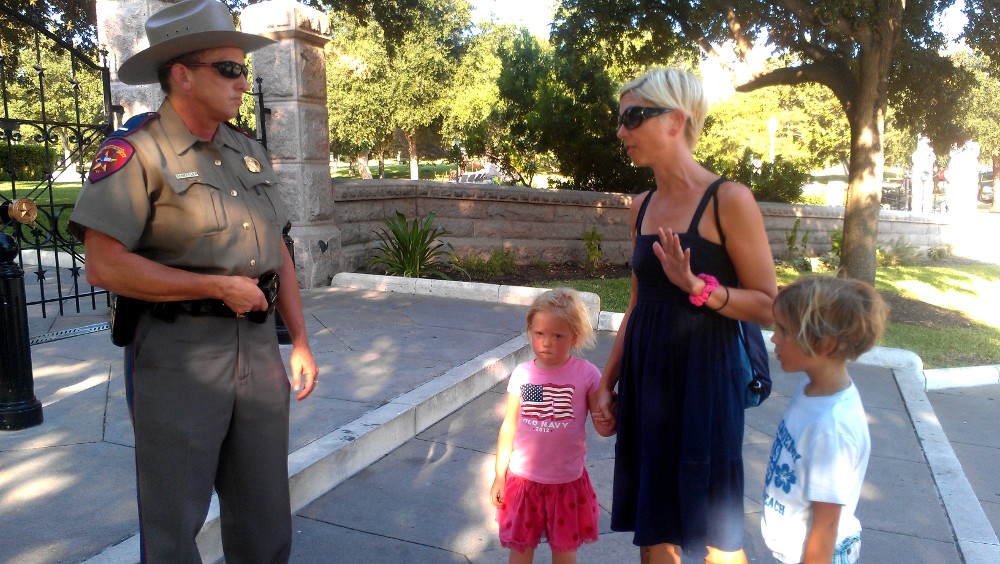
Holding her children's hands, Hillary Procknow confronts State Trooper.

Hillary Procknow confronts a State Trooper about chalk arrests. August 9, 2012. Photo: Kit O’Connell.

The three of us walked up to two troopers standing in front of one of the gates in front of the Capitol. Honestly not knowing protocol, I extended my hand to the trooper closest to me and said, “Hi, I’m Hillary Procknow.” Her arms remained around her chest. I fumblingly said, “Oh, I guess you’re not allowed to do that.” I explained to her very politely that I did not understand why two people had been arrested and that I was indeed concerned because my children were now afraid of police. “What,” I asked, “can you help me understand to explain to my children that they do not need to be afraid of the police.” She repeated what the other officer had said about chalk and criminal mischief. I reminded her that chalk is not explicitly mentioned as mischief. She said that just like free speech, if a citizen is offended by what someone says (or chalks) an officer can tell the person to stop or arrest them. No trooper had explained that a citizen had complained. I replied, “I’m offended by what a lot of people say, but that doesn’t mean I want them to be arrested.” In any case, when I pressed her about what I should tell my children about their fear of police, she recommended that I go home and have a discussion about how it’s wrong to damage public property, and that it was going to take tax payer money to remove the chalk. I offered to go home and get rags and buckets. She said it wouldn’t make a difference. Of course, we did go home and have a discussion. I did tell my children not to be afraid of police. (We are not people of color, so it’s a lot easier for me to say this to my children than it is for others. If we had dark skin, this particular issue would have been much more complex. And that conversation will come, too.) But, I also told them that our country is not perfect. Just like at home, we all have to pitch in.

Many people wonder, I’m sure, what chalking a sidewalk does to make this country better. I want to be clear on this. People coming together, in public, to express themselves is something that makes the country better. I don’t mean this to apply to any particular political persuasion (and, in fact, Occupy has a firm stance on its resistance to embrace any particular party). When people meet each other, disagree, agree, argue with civility, see each other’s faces, learn to be in a public space and tolerate the presence of others, important things happen, and not necessarily or even mostly sweeping political change. The country learns what it looks like when people participate, when people recognize each other as human. The country learns what it looks like when people decide for themselves to think beyond political platforms and party lines, and come together to imagine new possibilities that simply are not available on a ballot coming to you in November.

Jane Addams, one of the great educators in our country’s history, who fought for the rights of poor and women, for sanitary conditions for immigrants all over Chicago, had some reservation about women’s suffrage, which she did fight for. Why? Because she knew in the 1910s what we have witnessed over the past 100 years: when people have the right to vote, it’s all too easy to dismiss the other important civic obligations they have. Did I vote this season? Yes? Check. Done with my responsibilities. When you feel your obligations are limited to a multiple choice form once or twice a year (if you’re a very conscientious voter), you have failed to understand every other obligation to your country, your fellow citizens, your neighborhood, your local public school, the poor, the sick, the marginalized. Being in public and expressing in public are ways to make this country better. Not the only ways, certainly. If I should have known better than to bring children to a public display of dissent, then I truly hope people will come out in public and make the public a safe place for all of us to be.

The two arrested Occupiers were charged with Class C misdemeanors. Apparently the charges may be increased to Class B. Class B misdemeanor charges result when the damage done costs between $50 and $500 to remedy. The cost of erasing dissent, in this case of erasing chalk from a public sidewalk, will cost tax payers less than $500. The cost of erasing dissent, by making the country’s citizens fearful of participating in a robust public sphere, by making them fearful of coming together, by making its children afraid to be with others and afraid of the police, will be paid for generations to come.

Epilogue

It rained the next day.

-Hillary Procknow, PhD-

Posted in Chalkupy, StoriesComments (0)

The Tree Lady


Editor’s note: This is the seventh in a series of excerpts from Jim Gober’s book titled “Deep in the Heart of Occupy Austin.” A new excerpt will be published at OccupiedStories.com every Wednesday, so come back next week to follow Jim though the evolution of Occupy Austin.

After writing most of the day, I left the house in the late afternoon. As I was locking my front door, I glanced over and saw my neighbor, Margret Hofman sitting in her driveway. She is known as Austin’s Original Tree Lady, because of her life-long work for Austin environmental concerns, especially when it comes to trees and tree planting. She is instrumental in implementing the city’s first tree preservation rules and created a registry of Austin’s largest trees. She served on the Austin city council in the 1970′s. Although wheelchair-bound and nearly 90, she is still very interested in what is happening beyond the confines of her home, including the Occupation, of which I am keeping her updated.

Margret Hofman, Austin's "Tree Lady" Photo: Jim Gober

She waived me over, and when I told her where I was going, she asked me to check on what the protesters call “The Island” but is actually her namesake park, a small triangle-shaped grove of oak trees and landscaping with a large rock in the middle located across Cesar Chavez from City Hall. It was officially named the “Margret Hofman Oaks Park” less than a year ago to commemorate her work. The island is where most people congregated the night the plaza was power-washed and the arrests were made because a few people refused to move out of the way of the power-washers. It is also a place for the cops as well as the protesters to cool off under the impressive oaks. Margret was concerned it was being trampled by the cops and protesters. I told her I would check on it as soon as I arrived. And of course, it was the first thing I did, and everything was in good shape. The plaque with her picture and information was perfectly positioned on the biggest rock so the golden setting sun would highlight it every day.

While I was there, I noticed a lady standing alone on another rock holding a protest sign. Her name was Carmen. She was born in Puerto Rico, moved to Spanish Harlem, and then moved to Tacoma, Washington. She said the green lands in Washington were so beautiful and a shock after living in the concrete canyons of New York, and she fell in love with the natural spirit that is Mother Earth. At 20 years old, Carmen hopped on a plane and turned 21 on a beach in Puerto Vallarta, Mexico where she lived for several years. It was there she questioned integrity, common sense and humanity. She believes common sense is stolen from Americans at an early age by our standardized educational system and rigid conformity to useless, degrading and dehumanizing social mores. She sees a society that is so jaded and citified that people don’t even know they are in a daze. It frightens her to see humanity this way-so disconnected from each other.

Carmen was out of the country while the cell phone and PC culture hit in the 90′s and was shocked when she returned because of the human isolation, commercialization and “not one authentic thing coming from anyone.” It is the dehumanization that is going on and how we’ve become incapable of feeling for each other that disturbs her most. She said, “If we don’t have a heart, how do we care for each other?” Carmen went on, “Information is great, but it is only healthy if we can process it and who today can process all this information and still have time to care for humanity? If you have too much incoming information your mind goes mad. That is why we have dissent and stress. The corporations that constantly push out all this worthless information are the root of all this stress.” Carmen said she spends a lot of time in her apartment, or “The Grotto,” as she calls it, and as long as there is food there she can stay safe and happy. And I was guessing she was in her late sixties, but had the skin of a 25 year old. Her beauty glowed from within. A beauty built on a lifetime of awareness and a desire to help others, not a lifetime built on bullying other people, deriding those who she perceived were inferior or having her face stuck into an iPhone or a TV.

After we chatted for a while longer, I walked across the street to the plaza and met Larry. Larry is holding a silent vigil about 150 feet down the street from the honk if yer horny line. He is in his 50′s and after noticing him there every day, I decided to see exactly what he was up to. His sign is kind of hard to understand but the number $40,000,000 is fairly easy to see. So I asked for an interview. Larry is a veteran who had a tough life after the Vietnam War. He found God one day in church with the help of a lady he met a few years back. He prayed that day God would help him build a place for homeless veterans, with hot showers, meals and recreation areas. God also told him it would cost around 40 million dollars to build his dream, and that is what he is asking for by patiently holding his sign, praying and hoping. When Larry left church the day he found God, he looked on the ground and found a 20 dollar bill and thought it was surely a sign; the beginning of his journey. And he’s been on that path every since.

So there Larry stands every day, in the same place he will stand long after the occupation is gone, because he wants to open his heart and help someone else. Although he has nothing of material value, Larry is still trying to get something for his brothers and sisters who suffer so badly. Larry has emphysema, COPD and peripheral artery disease, but is confidant God will grace him with the money he needs for his mission before he dies.

At the end of the day, I looked toward the corner for Larry. He was sitting patiently on the short stone wall that lines the sidewalk, partially hidden in some native grasses under a small oak tree. He was barely visible in the faltering light of the evening, but I could make out his silvery short beard, his sunburned face and clean red button-up shirt. He stared straight ahead into the passing traffic as he could plainly see the clear-cut path to his destiny. His shoulders were erect as any soldier, but even from that distance you could see the exhaustion from pursuing his mission for his brothers and sisters on the hot pavement the entire day. A car, pedestrian or chatty young idealist on the way to the plaza passed him by. Then another, and another and Larry faded into the blue-gray ether of the evening until he was no longer visible from where I was standing.

I chatted with Gabe, who was in his early 20′s, and has a good job as a draftsman. He came out to make his voice heard because he doesn’t want his future consumed with corporate greed at the expense of everyone else. He had everything going for him: a job, good looks, and a heart. He was hardly the bum or wacko the corporate press is trying to make us all out to be. And he had a good point when he said politicians running for office now don’t need millions from corporations, they have a free social network to exploit. They don’t even have to go door to door anymore.

I talked to Zach, who has a PhD in Mathematics and is a teacher at the University. He was discouraged the best mathematical minds are not used to solve societal problems, but are instead hired by money managers and banks to figure out ways to screw people when they invest in the stock market. He was also dismayed that math is not taught as a theoretical problem-solving technique but rather as a series of standard problems, such as 2+2 =4, and if you get it right on the test, you don’t have to worry about math again the rest of your life. He said students aren’t being taught to think, they are being taught to follow.

Then there was a general meeting and time for speeches. I signed up for a short speech by talking to Kevin, a young man in charge of the speech queue, or stack, as it is known throughout the movement. There were quite of few of us gathered around to listen to the speeches and when my time came up I was nervous but grabbed the mike. Here it was:

“I just wanted to mention my neighbor, Margret Hofman. Now Margret came over from Germany after WWII where her Jewish mother died in a concentration camp. Margret was also in Dresden when the allies bombed it and even by a small count over 100,000 people were killed. So Margret knows a little about fascism and Margret knows a little about war, and Margret hates fascism and Margret hates war. And if she could, she would be right here with us right now.

But I wanted to tell you this: The little island across the street is named after her. Margret Hofman was a city councilwoman who was very important in creating the tree-loving environment we enjoy in Austin today. So when you look around, take a look at what Margret has done over the years with her activism and letter-writing campaigns and how even one person who is dedicated enough to a cause can make a difference. If you go over to the island and look at the big rock you will see a picture of her and a little information about Margret. The park is formally named Margret Hofman Oaks.

I just wanted to tell everyone to appreciate what Margret has given to us and let everyone know a little something about the place we call, “The Island.” Before I left today to come to the plaza, I told her I would check on her park and make sure it was OK. And if it wasn’t for that island, the police would have had everyone standing in the street the other night when they came to power wash the plaza. So I just wanted to say thank you Margret, and before I close, could I get a big hand for Margret and all she has done for us and this beautiful city?”

Everyone clapped and cheered and some yelled, “Thank you Margret!” And for the first time I got plenty of the good kind of sparkle fingers before I stepped down. I had just given a perfect speech. It was completely unrehearsed or thought about beforehand. I got up there simply because I loved someone who loved the whole world. A world that tried to destroy her time and again. But somehow, tonight, all of our hearts-Margret’s, mine and everyone’s at Occupy-for a perfect shining moment-had melded into one.

Although it was after midnight when I got home, I could see a dim blotch of light shining through Margret’s antique living room curtains. I gently tapped on the front window. The home healthcare lady that stays with her answered the door and there was Margret, wide awake in her rented hospital bed facing the door so she can see the sunrise every day. I told her everything at her little park was OK and that I gave a little speech about it and had recorded it for her.

As I played it she closed her eyes and listened to me speak as if she was listening to an orchestra inside the most beautiful concert hall in Europe, before the angst, destruction and terror of war and fascism had stolen her mother and engulfed her young and precious life. When it got to the part in the speech where I asked for the applause, Margret noticed it was loud and quite impressive. She opened her eyes and got the attention of her day-sitter who was ignoring the entire scene with her head buried in a newspaper. When the day-sitter looked up, Margret said with a smile, “Do you hear that? They are applauding for me.”

The above was written in October 2011 and just last week Margret took her last three breaths and passed into the garden. Today, I planted a small oak tree she had nurtured in a flower pot on her back stoop. Three weeks ago, Larry had emergency heart bypass surgery. Yesterday, I saw him standing on the corner by the deserted Occupy encampment which lies across the street from Margret’s park. His left hand was holding a wooden pole on which a huge American flag was mounted. It flapped unceremoniously in the chilly February breeze. In the other hand was his sign with the $40,000,000 still clearly visible. The traffic roared by.

Posted in StoriesComments (1)


Connect with us


Get Occupied Stories Monthly

A monthly round-up of [y]our best stories.

Where do our stories come from?


View Occupied Stories in a larger map