This page is part of a larger feature called Occupy: 12 Events That Defined Year One. In the run-up to #S17, the one year anniversary of the movement, we will be posting stories from our archives for every month of the past year of occupy. For November 2011, we’re remembering evictions at various occupy communities, and what happened afterwards. Read stories from other months >>
This page is part of a larger feature called Occupy: 12 Events That Defined Year One. In the run-up to #S17, the one year anniversary of the movement, we will be posting stories from our archives for every month of the past year of occupy. For October 2011, we’re featuring two stories from the October 1st march over the Brooklyn Bridge that ended in 700 arrests and marked a day of escalation for the movement. Read stories from other months >>
This page is part of a larger feature called Occupy: 12 Events That Defined Year One. In the run-up to #S17, the one year anniversary of the movement, we will be posting stories from our archives for every month of the past year of occupy, starting with stories on the first days at Liberty Square and the spouting of other encampments nationwide. Read stories from other months >>
As we approach the one year anniversary of Occupy Wall Street, Occupied Stories takes a look back at the events and actions that defined the first year of the movement. In the run-up to #S17 we will be posting stories from our archives for every month of the past year of occupy, starting with stories on the first days at Liberty Square and the spouting of other encampments nationwide. Be sure to check back often!
Featured Month:
August 2012: A Focus on Debt
New York, NY-Debt to Burn: #StrikeDebt puts on a debt burn as the first step toward a debt refusal movement.
Oakland, CA-The Cost of Helping Others: Despite 6-figure debt, a massage therapist sees worth and value in following his dream: “Why would anyone shy away from this depth of love, at any price?”
Turners Falls, MA-InDEBTed to Education: A former student is pessimistic about a debt-ridden future granted to her by a school with an allegedly corrupt administration.
Denver, CO-On Sunday July 29, Occupy Denver marched to support the citizens of Anaheim, CA in their ongoing resistance against their city’s violent and racist police force. This action brought attention to recent police atrocities in Anaheim, and served as a reminder that Denver’s own police department is essentially a taxpayer-funded street gang with a detailed history of murders, racist beatings, and political repression. (See the links at the bottom for documented cases of Denver Police atrocities.)
Here is my personal account of my participation in the march and my false arrest by DPD:
I arrived at the march as it staged outside the skate park. I had my bicycle with me, and rode my bicycle throughout the march, mostly because biking requires less energy than walking. The march took the streets and went under the underpass by the Rockies stadium as we made our way downtown. We unfurled our banner reading “Stop Police Oppression– Solidarity with Anaheim” and chanted phrases such as “Justice for Anaheim”, “We want equality, stop police brutality” and “How do you spell injustice? DPD!”. At least four DPD vehicles began following us at this point, and they blared their sirens in an unsuccessful attempt to keep the game day crowd from hearing our message. The leading DPD vehicle was an SUV driven by one William J Andrejasich Jr, a Sergeant in DPD’s Special Events division.
We made our way to the downtown area of Denver, and Sergeant Andrejasich and his colleagues repeatedly attempted to use their voices and vehicles to discourage the march from keeping its message in the street. DPD prefers to see political expression confined to the narrow sidewalk where it cannot affect business as usual. This march had other ideas. I myself chose to remain on my bicycle in the street, as riding my bicycle on the sidewalk would be a violation of traffic laws and DPD will use any excuse to harass and arrest known Occupy activists.
The march continued down the 16th street mall as we continued to agitate and inform the public about the police murders and subsequent attacks on residents in Anaheim. Our police escort continued to ride very close to us until we arrived at Civic Center Park. After the police caravan departed, we decided to resume marching. We made our way through Lincoln Park and began marching past the Capitol on Colfax Ave.
As the march approached the intersection of Colfax and Pennsylvania, several DPD vehicles pulled into the middle of the street and officers stepped out of the vehicles. Sensing that DPD was looking for a fight, the march diverted onto the sidewalk. At this point, three officers charged our “Stop Police Oppression” banner, one of them striking it so as to break the wooden support pole holding it together. After breaking the banner (which appeared to be the primary target), the officers proceeded to grab and arrest the protester who had been using the megaphone to decry police violence throughout the march. They led him away into a car, and Sergeant Andrejasich barked at us that “if you go in the street again, we will arrest you.” This threat seemed absurd given that whenever we march, DPD’s vehicles that follow us essentially shut down traffic anyway. Sergeant Andrejasich was clearly hoping that by threatening arrest and possible violence, he could frighten our solidarity march into giving up and going home. He should know by now that Occupy Denver doesn’t play like that. Having seen DPD use violence or the threat of violence countless times to attempt to silence dissent, I figured someone should resolve Sergeant Andrejasich’s confusion about the relationship between his department and our subversive assembly. Using the megaphone dropped during the recent arrest, I told him that “Occupy Denver does not negotiate with terrorists, and the Denver Police Department is a terrorist organization.” Upon hearing this, Sergeant Andrejasich instantly went red in the face and grabbed my wrist, at which point he and another officer pulled me into the street, and while holding my wrists attempted to twist my arms into a painful position (I have a sprained wrist and was wearing a splint). I was handcuffed, and when I asked Sergeant Andrejasich why I was being arrested, he replied “for obstructing the street.” I told him that I was legally on my bicycle for the entire march route and he said nothing in reply to this. He then handed me off to two other officers who placed me in a car and took me to DPD’s offices in the Downtown Denver Detention Center. Interestingly, Sergeant Andrejasich is not listed as my arresting officer, and none of my arrest paperwork contains any of his information. We only know it was him due to his past interactions with our group. Before I was processed into the jail, I sat in a DPD District 6 cell while I listened to three officers outside the cell flip through the book deciding what to charge me with, highlighting the fact that this was a false, politically-motivated arrest. Upon being booked into the jail, I was informed that the megaphone I used had been confiscated by the police, presumably as “evidence” of my obstructing the street.
Two more arbitrary arrests of protesters were made after my own; during one of these arrests a ten-year-old child was forcefully knocked to the ground by one of the arresting officers. The march continued well after my arrest, culminating in a heated standoff between the remaining protesters and a heavily armed line of officers outside DPD’s District 6 headquarters as the march chanted “free our friends” and continued to hurl passionate criticism at Denver’s corrupt, racist, and violent police force.
After the march subsided, a group of occupiers gathered outside the jail awaiting the release of myself and my arrested comrades. Sergeant Andrejasich again approached this group, and told them that they were creating a disturbance (even though they were being quiet) and that as a warning had already been issued to the group, he could arrest any of them at any time with no further warning. Sergeant Andrejasich seems to believe that he can operate with impunity, arresting activists simply because they irritate him or offend his political views even when no laws are broken.
Sergeant Andrejasich’s comic arrogance represents DPD’s belief that they have the sole power to decide who is breaking the law and have the right to choose when to selectively enforce these laws. Everybody knows that jaywalking is common practice in Denver; one can jaywalk in front of a police officer without any fear of reprisal. However, when one is walking in the street as part of a radical political march, DPD suddenly decides these laws are worth enforcing with great zeal and armed force. Occupy Denver rejects the Denver Police Department’s twisted, politically selective interpretation of municipal codes, and we reject their claim that they protect and serve the citizens of this city. Their long record of murders, racist beatings, and politically-motivated violence makes their moral depravity obvious to anyone who is paying attention. We call on the City of Denver to condemn this corrupt and criminal police department, and to take their destinies and the safety of their communities into their own hands.
Our Anaheim Solidarity march was just one small part of the struggle against police oppression in Denver. There is a long history of resistance against police oppression in Denver, and this resistance is ongoing. We encourage everybody to attend the upcoming March Against Police Terror, which meets on August 21st at 6 PM in La Alma Park (13th & Mariposa). More information on this important community event can be found here:
Here is a short list of news stories related to Denver Police atrocities outside of their attacks on Occupy
Denver:
Recent murder by DPD
DPD murdered an innocent man last summer, the murdering officers faced no consequences
In 2009, DPD officers beat a man within an inch of his life while yelling racial slurs at him
DPD recently reinstated, with back pay, two officers involved in the infamous Denver Diner beating
In 2010, Denver Sheriffs tased a man to death in the Denver jail simply because he would not take off
his shoes. All officers involved were cleared of wrongdoing.
It was surreal standing in the middle of art walk with two friends knowing that Occupy LA were essentially banned from Spring Street due to a police riot that broke out a month before. On July 12, 2011, the LAPD shot rubber bullets into a crowd of art walk attendees mixed with members of Occupy LA, myself included, because some were writing with chalk on the sidewalks. In an effort to avoid any more injuries from police violence, the Occupy LA General Assembly accepted a proposal effectively relegating all activities related to “chalking” to Pershing Square for the August 9th art walk. Occupy LA also called for solidarity “chalking” actions across the World on the same day.
In the week leading up to art walk, the LAPD arrested members of Occupy LA for chalking and other public misdemeanors, while the media published various articles debating the LAPD’s use of a vandalism law to arrest people writing with chalk. Early in the morning of August 9th, the cops detained members of Fresh Juice Party shortly after they finished an enormous chalk mural in Pershing Square. Later that day, the LA Times reported that a fist fight broke out between someone from Occupy LA and a visitor from Occupy Oakland over chalking skills. This only compounded the tensions that were amplified in the media over the LAPD “bracing” for Occupy LA’s return to art walk.
“No stopping! No talking! Just buying! Everything’s fine!” I shouted as people passed on the crowded sidewalks of 5th and Spring. My two friends and I posted up near a KCAL reporter on the corner and unfurled our “Class WARhol” banner, while another held a sign that read “Legalize Art.”
Within a few minutes we were asked to move by the LAPD. We crossed the street and stopped again. This time we positioned ourselves behind a parked police car and a fire hydrant, so as not to disrupt the flow of pedestrians. LAPD Sergeant Bogart approached us on his bicycle and said “I’m going to need to ask you to move.”
My friend replied, “Where to? Three feet this way? Three feet that way? We were just told to move from the other corner.”
“I can’t tell you that. You just have to move” repeated the Sergeant.
I was looking down at my feet, a bit nervous to be around so many police, when I saw spit land next to my right foot. I looked up and asked the Sergeant, “Did you just spit at me?”
He smirked and said, “Does that make you feel intimidated?”
Choking on my words, I quietly said, “Why? Should I be?”
The Sergeant spit to my left side and smiled, “Did it look just like that?”
My friend then asked the Sergeant if it was department policy to allow officers to chew tobacco while on duty, to which the Sergeant replied, “I see we are going to have a problem here.” The Sergeant then got off his bike and spit again. This time it landed a little further from me, but still within a few inches.
My recent research into police tactics during protests made it easier to detect what the Sergeant was doing. He wanted either me or my friends to overreact to his taunts, so that we could be arrested and the LAPD could declare a moral victory over Occupy LA in the morning’s press. I stepped back and stated loudly “I am backing up! No need to spit at me!” By this time, there were at least five cameras on us, yet no one intervened. Because the cameras were not there when the altercation began, there is no ‘proof’ of his assault, but because the cameras were present during the aftermath, they may have protected me from further insult. Ironically, I had two cameras on me, but did not want to be shot for “reaching into a pocket” like so many others. Due to the Sergeant’s smugness, I have no doubt that this man has used a similar tactic to force compliance on other occasions. All that remains is my word and those of the witnesses against the Sergeant. I imagine the frustration I experienced is quite common in communities that are forced to interact with the police “for their own safety.”
The situation gives me pause to reflect again on police provocation, testimonies, and cameras. If anyone surrounding me did intervene, the consequences for all could have been tragic. There were no less than 30 police officers in that intersection, some on horses, others on bikes, and many on foot. The build-up by the local media to Occupy LA’s attendance at art walk, like Tyson Vs. Holyfield, put everyone on edge. No one wanted to back down. By spitting at me, Sergeant Bogart could have triggered a much larger reaction that would have provided the rationale for deploying hundreds of extra police to stamp out the vestiges of political speech in Downtown LA.
I remained collected enough to walk away with my body intact, but my dignity obliterated. The next day, The LAist wrote that Occupy LA claimed that the LAPD stood down (which they did because there were no arrests in a chalk covered Pershing Square), while the LAPD claimed that Occupy LA backed off (which they did because they did not go to art walk en mass). Importantly, this battle of Los Angeles has nothing to do with the medium of chalk as reported in the media. For the LAPD, it is really about vilifying those already marginalized and legitimating the increased policing of downtown, but for Occupy LA it is about slowing the gentrification of downtown in defense of the very poor.
The abundance of police during art walk- and in downtown more generally- has been questioned many times before Occupy LA even existed. In fact, the majority of Occupy LA unknowingly stepped into the debate after the raid on November 30, 2011. For years, the LAPD and The Central City Association’s private security have patrolled art walk to stave off the wayward homeless from neighboring skid row, so that the very poor, with their cries of hunger and untreated open wounds, do not disrupt the roving middle class crowd. Moreover, the art walk crowd is taught to fear skid row as lines of cops audibly warn middle class attendees not to travel far from Main Street.
My “Class WARhol” banner was designed to engage intelligent art walk attendees in conversation about the on-going class war in LA’s historic downtown core. I spoke with some art walk patrons who thought the banner was clever, but did not know much the treatment of the very poor in downtown LA. Others knew about the dangers of life on skid row (including rampant police harassment), but did not know that the police typically searched and arrested homeless people from skid row in preparation for art walk. While the galleries are busy washing their walls white to prepare for new art, the LAPD and CCA security are conducting their own kind of whitewash just outside.
CCA Prepares to “Clean Up” Skid Row
“Clean streets” in downtown LA does not simply mean removing trash and washing human waste into the gutters, it really implies ridding the streets of poor people and what little they own. Recently, it has come to include removing all memory traces of political speech by erasing the most ephemeral form of expression: sidewalk chalk. In the case of Occupy LA, they are getting lambasted by the police for calling attention to the problems of the very poor. Even more disheartening though, the shifting demographics of Occupy LA over the last 3 months are used to justify the actions of the LAPD - the poor, gay, black, and brown are now at the forefront of the Occupy movement and consequently, they bear the brunt of the attacks from the police. These populations are the favored marks of an institution that derives its own authority by depriving the people of their own power.
Lastly, I am beginning to better understand the imperative of ‘camera power’ to new social movements. Footage of cops enforcing their requests does in a flash what it might take years of filing official complaints to accomplish, the images reveal the non-institutionalized means by which compliance is actually accomplished: spitting, hair pulling, arm twisting, finger bending, and so on… all the things that children usually resort to in order to get their way. Resembling Tyson, when faced with an opponent that won’t yield, cops must also resort to cheating. Sadly though, like DNA evidence, future reliance on technology is at a cost to human witnessing itself as people’s testimonies become a comparably less authoritative account of an event. Like I said before, ‘give me the YouTube link, or it didn’t happen!’
Editor’s Note: This story originally appeared at assangenyc.org.
New York, NY-I am currently writing this blog piece, inside England. Well not literally, but legally speaking. I am currently under the roof of the British Consulate, seeking (non political) refuge from the rainstorm here in New York City on 3rd avenue and 51st street. For Julian Assange, the thin line that divides him between the Ecuadorian embassy and Britain Proper literally is a matter of life and death. British Police have been ordered to arrest Assange the moment he steps off Ecuadorian territory. If he is arrested and sent to Sweden (with the advice of Karl Rove) he’ll likely be extradited to the US, where our government may indict him on conspiracy/espionage charges, which could result in execution by the state.
I am currently completing my second night here at my promptu call-out indefinite Occupation of British Consulate in NYC, in solidarity with Julian Assange. Within minutes of tweeting it out on @OccupyWallStNYC, Russia_Today mentioned it, and it started getting many “guests”. Later, Michael Moore and the Guardian mentioned it as well.
The Tweet heard around the World
It was really exciting seeing how one tweet, later turned into multiple other occupations, from Los Angeles, South California to Sydney and Ecuador. I inspired some, and many inspired me to make that tweet and promptu occupation in the first place.
Our single demand for this occupation is “We will not leave, until Assange can leave.” It is not the only demand I have, but the consequences of that one demand would restructure society in a domino effect.
I acknowledge there is nothing immediately practical about a 24/7 occupation. There are logistical and legal constraints, as well as limited Internet and electricity. Yet, there is something highly symbolic, and sentimental, about refusing to leave the “sight” of the oppressors, until they change. To quote Frederick Douglass: “Power concedes nothing without a demand”
I also see it as an opportunity to continue the dialogue globally, pertaining not just Assange, but also Bradley Manning, war profiteering criminals, repression of the state etc.
I envision different organizations and communities volunteering everyday to give teach ins, skill-shares about activism, political mobilization, harnessing powers of social media and more. It can be funky too, using film projectors to broadcast on the walls of the consulate, films such as Wiki Rebels or Assange: Sex, Lies and Sweden or even Collateral Murder. Let us celebrate Ecuador’s brave motion to continue to house and protect Assange. Nothing like declaring America’s independence from England (for a second time).
Contrary to previous experiences with organizing political protests, the police here do not see this as a threat to their or the Mayor’s legitimacy, and thus have largely left us alone. That may change when they see we are not leaving for good, until our demand is met, but we shall see. The fight here is not directed at the Police state, but make no mistake, the Police state are a firm branch in the tree of the very fascism we fight. Our occupation is participatory, and if you or your organization are in line with our demand, then this occupation is yours. Join us. Change us. Expect us.
We are in front of British Consulate, 845 3rd Avenue New York, NY 10022.
Editor’s Note: This story is part of our ongoing first-person coverage of protests in Quebec against student debt, tuition hikes and Law 78, as well as actions elsewhere in solidarity to those causes. This post originally appeared at Outside the Circle.
Montreal, QC-On August 10, I posted a photo on my Facebook page of a delicate red square with the caption “[the] fragility & sweetness of social struggle.” Little could I have guessed, however, just how fragile the Quebec student strike movement would prove to be only three days later. On August 13, in hugely attended general assemblies, students at three cégeps (pre-university/vocational schools, part of the legacy of free and accessible education won in the 1960s’ Quiet Revolution) voted away their own collective social power and political bargaining chip: the strike. Within hours, the students went from having the offensive and creating a crisis for the government to letting the government’s scare tactics of provincial elections/repressive law work their magic and gain the upper hand again. It’s been the same story every day this week.
Two courageous cégep general assemblies, against all the odds and intensity, held firm to the strike. After that vote, a small group of “anti-strike” students who lost used a procedural mechanism versus the good faith within the assembly structure to petition for re-votes at both those cégeps tomorrow morning: Vieux-Montreal and Saint-Laurent. The school administrations then heaped on additional pressure to not only support the re-vote but overturn the strike (word is that the admin at Vieux-Montreal has even threatened students with failing them completely if the strike goes forward).
There are moments, I’m discovering more than ever, of profound crossroads in social movements, when momentum swings in one direction or the other, and moreover, when it’s important for people to stand up in solidarity with those who feel scared or pressured to back down. How people view what’s happening at such a critical juncture matters in terms of sustaining a social movement . There are still tens of thousands — upward of a hundred thousand or more even — students still under strike votes at various schools, including the colleges and universities that start later this month and into September. There is still a huge social movement, and still many students who support the strike but voted, often out of fear, to end or supposedly delay it for a bit (by and large, the state’s psychological warfare worked). Many people (including many students) are now calling the cégeps’ votes to end the strike “a truce,” hoping that students will pick up the strike again after this short “extra” semester — added because of the strike and lost class time. But a truce implies two camps both equally making ceasefire concessions; in this case, the provincial government has bludgeoned the student strike to near death. And it’s not so easy to simply restart a widespread strike, much less a social movement.
All to say, what happens now matters a great deal in terms of this strike and social movement, not only here, but also as inspiration and hard-learned lessons for other struggles globally. It matters a great deal what those many tens and hundreds of thousands who are part of this social movement do at this point — students, teachers, staff, neighbors, workers, and so many others — after six long months of resisting in all sorts of imaginative, strong, and bold ways.
Those many students still holding collectively to the strike tactic — not just for themselves but also for notions like free education for everyone and forms of self-organization, and so intimately tied into a larger austerity struggle — need our solidarity, strength, and love right now. In particular, Vieux-Montreal students favoring the strike are asking for a large show of folks and support outside their school tomorrow morning, Friday, August 17, at 8:00 a.m. (Ontario and Sanguinet in Montreal), standing with them in whatever way they ask of us. Here’s the Facebook page for the assembly itself: http://www.facebook.com/events/142331402574320/. It’s unclear whether Saint-Laurent wants supporters there or not — out of a concern that nonstudents there might be seen as meddling in a difficult moment for the Saint-Laurent students — but there is one Facebook event asking for a demonstration at 9:00 a.m. (http://www.facebook.com/events/258521384265430/).
I’ve been in numerous conversations this week about what the votes this week mean, what happened, and what next, among so many other discussions, speculations, and critiques, but also what solidarity looks like right now. At the same time, I and thousands of others have also been experiencing tumultuous waves of emotions, ranging from denial to anger to depression — all summed up, for me, as “heartbreak.” I’ve tried writing something about all of the above and more this week, ever since Monday, but every time I start, I end up staring at my computer screen, immobilized by a heavy sorrow that won’t let words flow easily. That’s a strange feeling for me. Usually words are what help me process difficult times and hard emotions. I’m not alone; nearly ever time I run into someone engaged in this student and social movement, there’s this bleak look in their eyes. It’s been a long, long, long and hard week here in Montreal.
Yet again I’m back to what feels like “lost in translation” even trying to explain it. The power — the social power — of this movement was the greatest I and many of my friends and acquaintances here have ever experienced. You come so damned close to what might just start tipping the scales toward a better world, closer than you ever dreamed possible, and in a matter of a few hours on a Monday earlier this week, it suddenly seems as if it all vanished into thin air. So many of us walked together on that illegal night demo on Monday evening, processing ad nauseam, until I think we all managed to convince ourselves again of spit and fire and hope. That we shouldn’t give up so easily. That now, more than ever, the social side of this movement had to step up, both in terms of what it is doing organizationally and to make its solidarity clear, so those still-striking students would know they have allies. Because if they vote to remain on strike, the state and police will certainly exert renewed and likely harsher force.
Which brings me around to tomorrow morning, soon. I don’t know if this is the right decision or not. I don’t quite know the right answer about what solidarity should look like in relation to the students — who started their own movement, and in turn birthed a substantive and far-reaching social movement that is now both dependent on the students and larger then them. Those in the social movement who aren’t students are definitely feeling the weight of that position this week. Many argue that we should thank the students for all they’ve done, understand their tricky situation, and not “take sides” tomorrow when we stand outside those one or two general assemblies, and perhaps that is the right view. After all, the autonomy and self-governance of each school (and often departments within each school) has been a touchstone principle and key to the organizational strength/growth of the strike as well as movement.
Still, I keep coming back to decisive moments, those quick and fragile instances when all is won or lost. Not crisis; rather, crossroads. And I keep asking myself, “Where do I stand?” Two days ago, a friend in Europe asked me to write 120 words about why I’m an anarchist for a German newspaper that’s doing a feature on anarchism and wants several of these anarcho-blurbs as sidebars. I joked that rather than sending him what amounted to a tweet or fortune-cookie insert, maybe I should just contribute one word: “freedom.” This evening, after the first-ever stressful autonomous popular assembly meeting in my summertime neighborhood (due, in large part, to the collective stress and heartache everyone is feeling), I think that I have my own answer to where I stand — always, always, on the side of freedom, even if that isn’t exactly solidarity or the popular thing to do come 8:00 a.m.
I’ll be at Vieux-Montreal tomorrow morning, not to disrupt the general assembly or scream at students I don’t agree with, but also not to neutrally be there merely to offer a general thanks. I’ll stand by the side of those students who want to continue to stand for the strike and all it’s come to symbolize, against all the psychological and physical warfare that’s been thrown at them to get them to back down.
And when my heart is feeling a tiny bit better, soon, likely after seeing these brave students tomorrow try to do what’s right, I’ll be ready to share a lot more about this bittersweet week.
* * *
Dedicated, in solidarity and with admiration, to those students at cégeps Vieux-Montreal and Saint-Laurent who vote to hold firm to their strike during the re-vote at their general assemblies tomorrow morning.
Photos by Cindy Milstein, from the walls of Montreal, summer 2012.
Editor’s note: This story originally appeared on the author’s Facebook and at the Occupy Austin website.
Austin, TX-On Thursday, August 9, I took my two children, ages 4 and 7, to an Occupy Austin event called “Chalkupy the World.” Many other cities around the country, and even abroad, participated in this event. I’ve been to a few Occupy events, support the methods and messages of Occupy, and am somewhat active in one of the Occupy groups that does work dealing with the local school district. The Chalkupy event was supposed to be a gathering of people using sidewalk chalk to express, well, anything really, but mostly dissent or disenchantment with the way things in our country have evolved to either favor the ultra-wealthy or punish the poor, middleclass, marginalized, or otherwise “different” people.
I anticipated that this was going to be a small event, and one that would allow me to show my support of the Occupy movement while also letting my children participate, or at least keep them occupied. They like chalk; they like to draw. I wasn’t really expecting police intervention. I’m a responsible mother; I would never knowingly put my children in harm’s way. I thought, particularly in Austin, this event would be reasonably innocuous. But I’m also responsible enough to want to teach my children to participate in the citizenry, to stand up for what they believe in. I can’t say I’m altogether surprised at what happened, which is really a sad comment on our society.
I took my children because I thought it was an appropriate place for children to participate in coming together, in citizens who don’t know each other meeting in person, in public space…in space that is for the public. I think it’s worth mentioning, too, that the day before, I had just read William F. Buckley Jr.’s essay “Why Don’t We Complain?” Writing in 1960, the famous conservative commenter remarked on how much people at the time were willing sit back without remark and endure unreasonable situations. He explains that it’s sometimes complex, that there are often hidden reasons for why some things are the way they are. But his essay challenged me. And on August 9, I was feeling a duty to myself and my country to speak up for things that seem unjust. If I didn’t, who would? How would my children learn to speak out against injustice?
We had picked up two packages of giant-sized sidewalk chalk earlier in the afternoon. They were the biggest chalk sticks I had ever seen, and I found their cartoonish proportions a little humorous. Two sticks in each pack. Two sticks for each child. I knew there would be more chalk waiting at the event, but it’s always good to come prepared. As we drove to the event, I reminded my children they could draw anything they wanted. I want my kids to participate in the public sphere, but I don’t want to be too heavy handed in what messages they feel forced to repeat. They will change their minds about many issues many times as they grow. I don’t think I need to force them to accept any point of view right now. I did tell them, though, that they might want to think for a minute about one thing they thought would help make the world a better place. My younger child thought about rain. My older child mentioned recycling. I told them that would be great, and that they could draw as many pictures as they liked.
When we arrived, there were about 10 Occupiers on the southwest corner of 11th and Congress, just across the street from the Capitol, where Occupiers had been warned not to use chalk. But we were all on public property on this corner. We noted the large box of sidewalk chalk on the bus stop bench. It had many more color options available. So both of the children picked out a couple of colors. My son, my older child, set in on his design. He decided that drawing the earth in a “recycling triangle” would be good. My daughter started drawing butterflies. She’s just recently developed the skill of representation, so her drawings are actually starting to look like something. I wrote a message about how I would be better off financially had I never decided to pursue graduate studies.
This is true, by the way. I would have been earning a middle class income from the time I graduated college in 1997 through today. I wouldn’t have any debt. In fact, in my one year working in a corporate office after I earned my bachelor degree, I saved over $7000 dollars. I’m pretty thrifty with money. I would not have had to take out student loans (all subsidized), and I wouldn’t have had to live on the approximately $800 monthly most graduate assistants make. Of course, I would not have become more educated about history, philosophy, justice, and education. It makes a difference in your perspective. It’s important to remember that education is not a commodity. I don’t owe money for student loans because I wanted a boat or an expensive purse. I owe money because I wanted to be an educated citizen. I thought that was a responsible decision. I’m still waiting for someone to tell me it would have been more responsible to keep my office job and keep my mouth shut.
The adults had already noticed the group of state troopers gathering across the street in front of the Capitol. Apparently, one was also hiding in a car across Congress. Whatever the case or the number of eyes, four troopers crossed 11th Street over to our corner. They promptly arrested two adults who had been chalking. One of the arrested chalkupiers was wearing a mask covering his face. When my children and I first arrived, they asked about the mask. I simply explained that some people like to be private. They accepted this answer without further inquiry. Indeed, children are often at ease when their parents or role models help make sense of the world for them and are honest with them about what they see. That’s not always a very easy task. Taking a moment to consider one’s response and how it will potentially frame the world for children does take a little more effort at times, but I’d rather not go around dividing the world up into “people like us” and “people not like us” for my children. I imagine there are parents who would have explained that the young man with a mask was just weird, wanted attention, thought highly of himself, whatever excuse they could use to make sure that their children understood that he was “different” and that “we” don’t act like that.
When the troopers came to our chalking area, my children were frightened. My son began to cry. He’s pretty sensitive, but very logical. My daughter feigned crying to be like her big brother. She’s big on drama and intensity. She has asked me to recount the story of the time I stepped on a nail when I was 12 years old a thousand times, but she’s not given to crying, unless someone else has tried to pick out her outfit for the day. Without any warning, the troopers arrested two chalkupiers. I approached one of the arresting officers and politely asked if he could help me understand why two people were being arrested. He deferred to the other who explained that chalking public property was considered criminal mischief. I asked if it was explicit in the penal code, if the code was specific in naming the use chalk on public property as criminal mischief. He explained that no, but it could be considered such.
Let us remember, too, that a number of courts have upheld citizens’ use of chalk as a form of expression. The Ninth Circuit Court of Appeals wrote, “No reasonable person could think that writing with chalk could damage a sidewalk.” (Mackinney v. Nielsen 69 F.3d 1002, 1995). To make this absolutely clear, in our country, we have freedom of speech to protect unpopular speech. This does not, however, protect use of dangerous or slanderous speech. We all know that we may not use words to threaten another or incite violence. That kind of speech is not protected. Similarly, had there been threatening messages or even obscene drawings, that use of chalk might reasonably be considered mischievous. But there were no such messages or drawings, only messages of dissent and drawings of the earth and butterflies.
After the troopers took the arrestees across the street, I calmly gathered my children and started toward the car. I certainly did not want to keep them in a place where they might be subject to violence or see their mother arrested for chalking. They were both teary. We walked for a minute. Then, I literally asked my children to stop for a moment while I thought. As a parent, you really have to do this sometimes. Sometimes, you have to stop and figure out what is best. If we left at that moment, what lesson were they going to learn? What meaning would they make of what just happened? Of course we were going to be discussing this at length; that goes without saying. But what would they take away from this event if, having told them it was not right for the police to arrest those two people, I simply walked away, too. I knew, already, I wasn’t going to go back to the chalking corner. So I simply turned around, crossed 11th Street to the Capitol, and I told my children I wanted to talk to the troopers, to see if I could understand what was going on.
Now, I’m an adult who (not that it’s anybody’s business) has never been arrested. And that might even be a damning statement against me, depending on who you’re asking. Because, without doubt, there is injustice in our country. We have one of the highest rates of childhood poverty in the “developed” world; we have the least amount of access to health care in the “developed” world; we don’t let consenting adults of the same sex enjoy basic civil liberties; we allow bankers who stole millions of dollars to continue their practices without so much as an investigation. These are surely injustices. Don’t get me wrong, I am thankful we live in a country where women are allowed to obtain an education; I am thankful our country attempts to educate every child, whether poor or rich; I am thankful for many things. But that does not absolve me from my duty to make this country better for the vast majority of people. What I’m stalling in admitting here is that talking to police makes me nervous. Which is a shame. At any rate, I had an example to set for my children. Children should learn to speak respectfully to officers of the law; they should be willing to approach one if it seems that something wrong has happened. And as a mother, I honestly did not want to walk away from this with children frightened of a police officer who might be trying to help them if they were lost or if there were an emergency such as a fire.
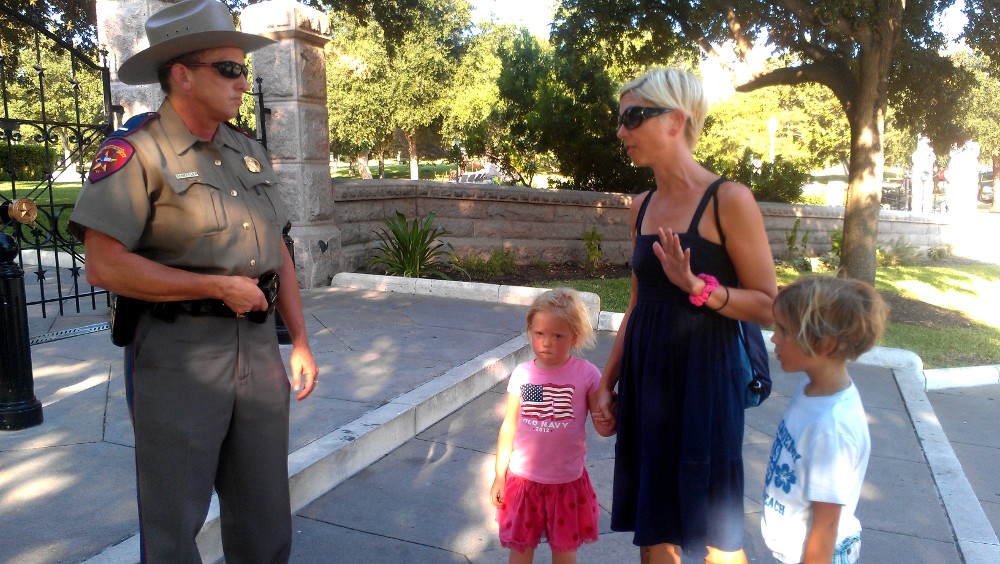
Hillary Procknow confronts a State Trooper about chalk arrests. August 9, 2012. Photo: Kit O’Connell.
The three of us walked up to two troopers standing in front of one of the gates in front of the Capitol. Honestly not knowing protocol, I extended my hand to the trooper closest to me and said, “Hi, I’m Hillary Procknow.” Her arms remained around her chest. I fumblingly said, “Oh, I guess you’re not allowed to do that.” I explained to her very politely that I did not understand why two people had been arrested and that I was indeed concerned because my children were now afraid of police. “What,” I asked, “can you help me understand to explain to my children that they do not need to be afraid of the police.” She repeated what the other officer had said about chalk and criminal mischief. I reminded her that chalk is not explicitly mentioned as mischief. She said that just like free speech, if a citizen is offended by what someone says (or chalks) an officer can tell the person to stop or arrest them. No trooper had explained that a citizen had complained. I replied, “I’m offended by what a lot of people say, but that doesn’t mean I want them to be arrested.” In any case, when I pressed her about what I should tell my children about their fear of police, she recommended that I go home and have a discussion about how it’s wrong to damage public property, and that it was going to take tax payer money to remove the chalk. I offered to go home and get rags and buckets. She said it wouldn’t make a difference. Of course, we did go home and have a discussion. I did tell my children not to be afraid of police. (We are not people of color, so it’s a lot easier for me to say this to my children than it is for others. If we had dark skin, this particular issue would have been much more complex. And that conversation will come, too.) But, I also told them that our country is not perfect. Just like at home, we all have to pitch in.
Many people wonder, I’m sure, what chalking a sidewalk does to make this country better. I want to be clear on this. People coming together, in public, to express themselves is something that makes the country better. I don’t mean this to apply to any particular political persuasion (and, in fact, Occupy has a firm stance on its resistance to embrace any particular party). When people meet each other, disagree, agree, argue with civility, see each other’s faces, learn to be in a public space and tolerate the presence of others, important things happen, and not necessarily or even mostly sweeping political change. The country learns what it looks like when people participate, when people recognize each other as human. The country learns what it looks like when people decide for themselves to think beyond political platforms and party lines, and come together to imagine new possibilities that simply are not available on a ballot coming to you in November.
Jane Addams, one of the great educators in our country’s history, who fought for the rights of poor and women, for sanitary conditions for immigrants all over Chicago, had some reservation about women’s suffrage, which she did fight for. Why? Because she knew in the 1910s what we have witnessed over the past 100 years: when people have the right to vote, it’s all too easy to dismiss the other important civic obligations they have. Did I vote this season? Yes? Check. Done with my responsibilities. When you feel your obligations are limited to a multiple choice form once or twice a year (if you’re a very conscientious voter), you have failed to understand every other obligation to your country, your fellow citizens, your neighborhood, your local public school, the poor, the sick, the marginalized. Being in public and expressing in public are ways to make this country better. Not the only ways, certainly. If I should have known better than to bring children to a public display of dissent, then I truly hope people will come out in public and make the public a safe place for all of us to be.
The two arrested Occupiers were charged with Class C misdemeanors. Apparently the charges may be increased to Class B. Class B misdemeanor charges result when the damage done costs between $50 and $500 to remedy. The cost of erasing dissent, in this case of erasing chalk from a public sidewalk, will cost tax payers less than $500. The cost of erasing dissent, by making the country’s citizens fearful of participating in a robust public sphere, by making them fearful of coming together, by making its children afraid to be with others and afraid of the police, will be paid for generations to come.
Chicago, IL - Sunday, August 12, President Obama stopped by Chicago to celebrate his birthday like most of us do: see some people, run around to a bunch of different places, pick up some money. He arranged for five fundraisers that day, totaling $4 million. For his third event, he came to Bridgeport Art Center on 35th and Racine to celebrate his 51st birthday with a few hundred of his supporters.
And me and my daughter and my comrades and our chalk.
Our action was simple: utilize our first amendment rights to colorfully educate Obama’s supporters on the public sidewalk. Secret Service and Chicago Police couldn’t stop us.
We grabbed our boxes of chalk and started writing messages on the sidewalks as people trickled in by twos and threes.
*#unHappy51 to Obama: A list of reasons to stand against Obama
*Obama criminalizes free speech and antiwar activists! Free the NATO5
*Welcome to Chalkupy Obama2012
*corporations are not people
*wish an #unHappy51 to Obama
*#occupyObama 9/3 to 9/6 Obama HQ
*Obama criminalizes free speech Free the NATO5
*Immigration rights now!
*Obama – Married to Corporations
*Peace
*Obama, we won’t be fooled again!
*Repeal NDAA
*#OccupyChi
*Obama admin deports millions – 400,000 per year!
*We are the 99%
*Obama stop killing brown people with your drones
*We need peace now
*Obama will not prosecute Goldman Sachs for their role in financial collapse
*Obama supports:
-death by drones
-deportatations
-Goldman Sachs
-silencing dissenters-
-NATO5
-NDAA
-Jeremy Hammond
-Pacific Northwest Activists
-Trapwire
-Occupy movement
-Environmental destruction with coal pollution
*Obama stop FBI & Grand Jury Repression of Pacific Northwest Activists
*Free Jeremy Hammond
*Obama is the drone president
*Hope for who?
*Obama kills ‘enemy combatants’ with drones
(enemy combatants = male, brown, Pakistani)
As supporters walked over our silent messages, they stopped along the sidewalk. Some read them aloud, taking pictures that would be tweeted out, looking at one another or the blonde, chalk-smeared little girl beaming at them. “Obama…kills brown people? With drones? What?” one was overheard saying. With a few bits of multicolored chalk, we managed to alter the discourse of the fundraiser. People inside were talking about our messages, Secret Service came over to read them, supporters snapped photos of them. Our anti-Obama messaging and education was effective with its engaging bit of expression because people chose to be seduced by the bright colors and coopted logo. They started to read and internalize the facts and possibly be sobered to realize there was no Hope and Change for them if they continue supporting someone who doesn’t support them.
Our lawyer remarked that our chalkupied messages were like the turd in the punchbowl. By shining light on dark facts of Obama as typical, 1%-serving politician, we reminded them to remember reality, not rhetoric. As a member of Occupy Chicago, I was not attending intending on a physical, imposing disruption. Our goal is empowerment through education. That day, it was my intention to spark people to examine their choices for a leader. It was my goal to start a dialogue where Obama supporters listen to why Occupy cannot be fooled by his words. We don’t support Obama’s broken society of drone strikes, immigrant deportation, silencing dissenters like the NATO5, Pacific Northwest Activists, Jeremy Hammond and opposing First Amendment rights, valuing corporations like Goldman Sachs over people, among many other charges. Only by standing together, all of the 99%, against oppression, false consciousness and illusions of choice can we begin to make substantive, systemic changes to create a better world.
Starting with a box of chalk.
For #occupyObama actions on 9/3 to 9/6 in Chicago, see OccupyChi.org