Tag Archive | "students"

Infinite Solidarity


Editor’s Note: This story is part of our ongoing first-person coverage of protests in Quebec against student debt, tuition hikes and Law 78, as well as actions elseware in solidarity to those causes.

New York -For the past 101 days (and counting), students in Québec have been on strike and in the streets against a crumbling education system that seeks to burden them with more debt and restrict access to education for the 99%. In recent days, hundreds of thousands have been in the streets of Montreal. The state’s response: Bill 78 - a Draconian piece of legislation that essentially outlaws mass demonstrations and severely fines those who participate.

Enraged and inspired by the images from Montreal and the recent #noNato protests in Chicago, a small but militant group gathered in Washington Square Park. It was Occupy Wall Street’s second night in a row marching in solidarity with the Québec student movement. We spent a good amount of time talking about what we wanted to do. Should we march or have a rally? Should we be doing outreach about the student struggle as well as marching? And what do we do about the ever-increasing police presence in the park (one count put it at 50 cops for about as many occupiers).

So we did what occupy does best: break-out groups. In small groups around the park, some of us drafted a statement of solidarity in English & French while others came up with an action plan for the march. I joined the statement-writing group and we hammered out a poignant few paragraphs in a short time. Luckily, some French speakers were on hand to translate as well.

As we were discussing the statement, the action planning group wrapped up and told us the plan as clandestinely as possible. After we reconvened and read the statement, the plan was to go “civilian” and find each other again on the corner of Broadway & West 4th Street, then march to Union Square.

The solidarity statement was mic checked by everyone in English and French. It rang through the park:

To our sisters and brothers in Québec as you enter the 101st day of the strike. For the second night in a row, we have assembled here to stand in solidarity with your fight for the human right to an education for all. Despite underrepresentation of your strength, your numbers, and your message in the mainstream media, we are watching. We at Occupy Wall Street honor your bravery, creativity and commitment to an organization built on direct democracy. You are an inspiration to us. You are not alone. Our grievances are connected. Your struggle is our struggle. We will continue to show our solidarity for as long as continue to fight in the face of the repressive laws of an illegitimate political regime. Stay strong and don’t give up the resistance! Thank you for fighting for all of us, and for future generations. We love you! Solidarity!”
Video via @diceytroop on Twitter:


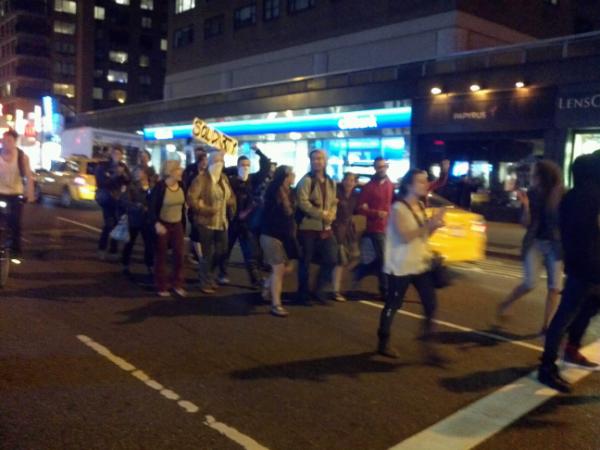
And then we dispersed, jokingly saying “bye!” and “see you tomorrow at 4 on Broadway” and giving out hugs and kisses. 15 minutes later we were together again, only this this marching north on Broadway. There were no cops. It was jovial. We weaved through oncoming traffic chanting “From Montreal to NYC, education should be free!” Some people didn’t take too kindly to us. There were shouts of “Get a job!” and someone even threw a water balloon at us from their apartment window. But there were honks of support as well. We stayed on the street the whole time and were small enough to move quickly and avoid police.

When we arrived at Union Square, we read the statement again and cheered “SO SO SO, Solidarite!” After a while a group of occupiers, high off the adrenaline of the streets, decided to head to Astor Place for an impromptu party. I decided to hang back in the park. There was talk of another march tomorrow. People liked the idea, some even said we should be marching every night. Amongst the twinkling of fingers and nodding heads I heard someone say the perfect phrase for what we were all feeling: “infinite solidarity.”

-Danny Valdes-


Posted in StoriesComments (0)

Frat and Stupid


Editor’s note: This is the tenth in a series of excerpts from Jim Gober’s book titled “Deep in the Heart of Occupy Austin.” A new excerpt will be published at OccupiedStories.com every Wednesday, so come back next week to follow Jim though the evolution of Occupy Austin.

By now, I had lost track of what day it was. The scene at the city hall plaza was very noisy. A man was using the PA to amplify his anger-filled speech that was becoming more obnoxious by the second. Most of the 200 or so people present were
wandering around aimlessly, and you could feel an enhanced sense of chaos. This was due to the constant onslaught of noise from the PA, the non-ending stream of pollution from the passing cars, drunken activity and general trashiness that gave
me a feeling the movement was being assaulted from all sides. The press was accusing us of every crime imaginable and deaths were being reported at various camps around the country from exposure and drug overdoses. There were hundreds of arrests in Orlando, Cincinnati, Chicago, New York, San Jose, Melbourne, and beyond over the last few days. The fascists were striking back hard. News reports from the propaganda machine said we were funded by Socialist billionaires like George Soros. When I heard that, I immediately thought about a recent general assembly meeting where everyone was angry that money was taken from the donation coffee can to buy dog food. I couldn’t shake how forlorn that coffee can looked sitting on the ground in the middle of the GA meeting. It was all taped up with a little slot left in the top so no one could stick their fingers in and pull out a few dimes. That pitiful excuse for a money source represented the lies perpetuated by the fascist propaganda machine being echoed ad nauseam throughout our country with the help of the brain-washed ignorant masses.

As predicted, this propaganda and balls-out fascist assault on our right to protest
and congregate in a public square was becoming a reality. Of course, no one, from
the President on down, stood up for us. And the corporate press is only printing the
bad news, and there is a lot of it. The crowd in the plaza seemed to be getting more
agitated by the minute, except for a group of about 15 doing yoga, which provided an
oasis of calm along the west side of the plaza. Decorum was undeniably breaking down
and once again, the God-damned PA, which had become an assault on the movement by
its sheer presence, was blaring out mindless bullshit, including an awful rendition
of Bob Dylan’s “The Times They are a-Changin” by an older man that would have
sounded much better without the PA. No one could concentrate or converse without
yelling at each other. Everyone was tired and we had not seen any progress over the
past 17 days except watching the descent of the plaza into a homeless camp with
plenty of drunks and speed freaks running amok. Just add a provocateur to this mess
and things will get uglier, if that is possible.

To be fair, plenty of us are still trying to get together for one interest or
another and the GA meetings are still being held among the din of confusion being
created by a crowd that tonight was totally out of control. Some younger hot shots
I’ve never seen are suddenly acting like they are in charge and running over the
old-timers like me. Magnets, those of us supposedly in charge of one thing or
another, that volunteered to do one thing last week, have abandoned their posts this
week. This was creating a chaotic scene where anything goes and all it needed was a
spark to put this night into a real downward spiral. And here it came walking up the
west side of the plaza. Three frat boys wearing khaki pants, blue blazers and red
ties walked out of the sunset with homemade poster board signs that read, “We are
the 1%” and “Get a Job.” I rushed toward them for an interview and stopped them on
the edge of the plaza. I positioned myself between them and the highly agitated and
intoxicated crowd, many of who wanted a piece of them.

When the boys-I say boys because these guys have never done anything to qualify
themselves as men-saw the aggressiveness of the crowd, they realized they had
suddenly jumped into some very deep water without their water wings. They rolled up
their signs and stood stock still, but still granted me the interview. I moved them
back further from the crowd. The trio consisted of a short guy about 5′ 6″, who will
never be any taller, named Chase, a 6′ tall leering half-Mexican with broad crooked
teeth and a touch of gingivitis named Justin, and a stone-faced boy with sharp
features and acne who stood a little over 6′ tall, named Cameron.

The interview was difficult because a Goth guy known around the camp as “Comrade”
kept pushing me out of the way as he was trying to stream the scene on his laptop,
and a young guy wearing those hipster Erkel glasses, named Nathan, who I had not
noticed the entire time I’ve been involved in the occupation, wanted to get in their
face. I told him to buzz off-that I had the interview-and he could talk to them in a
minute, and he screamed, “Who are you!” and “What are you doing here!” So apparently
Nathan didn’t believe anyone should be there but himself or have a right to say or
do anything. When he announced to the frats that his Dad worked at Chase bank and he
could have worked there if he wanted, I realized Nathan was no better than them, and
was exuding the spoiled brat ethic of mine-mine-mine that he was about to accuse his
college-attending counterparts of having. So now it had come to this, where someone
can come in and immediately start making their own rules, which in Nathan’s case
consisted of trying to indoctrinate a group of frightened frat boys into a chaotic
mess that was supposed to be a peaceful protest, but had descended into the image
the frat boys’ families (and the press) had handed them on a silver platter. But I
was still happy I got the scoop.

As it turned out, all three of the frat boys were freshmen at Texas A&M University,
which is where all the hicks in Texas with money and high enough high school grades
can go to college. It’s overwhelmingly white, and very conservative (GW’s daddy’s
presidential library is there.) It is located nearly two hours away, in College
Station, so the frat boys drove a long way just to agitate a few hippies. I wondered
what their conversation was like on the way there, and if they giggled like mean
little girls in anticipation of hurting someone they perceived as weaker than
themselves. I also wondered how brave they felt as they marched into the plaza
hoping to provide a beachhead for the next generation of right-wing doofuses.

I asked the boys what was in their heart that made them want to come down and do
this. Chase-the little one, said, “We are just concerned Aggies,” which is a slang
term for A&M students, “And were concerned why anyone would just want to sit around
and not have a job, not participate in the American dream, work hard and be at the
top of the totem pole when you are 50 or 60.” I thought, boy, did they get sold down
the river, but didn’t comment. So I asked, “Then you have a job?” Chase said he was
not working now. Justin said his first job will be as an intern this summer at an
oil and gas firm and Cameron worked as a lifeguard at a country club during the
summers during high school. So I confirmed that, “None of you has a job right now?”
and they all agreed.

Realizing they were already looking stupid, they begin to stammer while holding
tighter to their rolled up signs which were now the circumference of a nickel. They
said they were freshmen in college, so they didn’t need to work. The nauseating
smell of daddy’s money was emanating from their pores. It’s a familiar smell. It
comes out after spoiled kids get a few drinks in them. It is pervasive as patchouli
in Austin, and overwhelms the olfactory system such as when you witness a University
of Texas student who is not afraid of letting the cops know, “My daddy owns you!”
when he is being arrested because he is so drunk on daddy’s money he can’t stand up,
or when you are sitting at a downtown bench minding your own business, and a
hiccupping sorority girl, so drunk she’s lost one of her shoes, informs you that you
are scum and have no right to just sit there like that.

All the frat boy provocateurs agreed they were from wealthy families, and when I
asked, “So you’ve never had to really struggle for anything, have you?” They all
said no, but the little boy, Chase, said this was more of a symbol, “because the
protesters represent the 99% that doesn’t want to work, while we represent the 1%
that does.” I asked him, “So all these people out here make you sick, is that
right?” And he said, “Yes, for the most part,” as he eyed one of our women. This
sent the crowd around them into a feeding frenzy, and I had to yell the last few
questions and use my elbows to keep the crowd at bay.

Then I asked, “So when you get out of college, do you think you have a better chance
than other college graduates to get a job?” They all said, “Yes.” Then I established
that not one of them had any college debt and didn’t need it. They all claimed to
have some scholarship money, but it was the type daddy’s business friends swing your
way when you’re rich. I established that everything else came from daddy, they drove
there in the car daddy bought for them and they were wearing clothes daddy bought
too, and daddy’s money even bought the poster board and sharpies for them to come
all the way to Austin to show their ass. You know daddy was so proud. The insanity
of the whole fascist assault on the occupiers that was being played out in the press
could be explained in this little scene. None of these guys had a job or even needed
a job because their road was paved with daddy’s dollars as far as they could see and
their signs demanded that we, not them, “Get a Job!”

Sadly, the system is rigged for them. They won’t leave college in heavy debt, and
will have a leg up on everyone else because they got daddy’s money and no heart,
obviously. There is no reason these little pricks should have it better than anyone
else. None. Fuck them and their daddies and fuck the system that created those
little monsters.

The group surrounding them was out for blood at this point, and things were rapidly
breaking down. Nathan, with the Erkel glasses, wanted a dialogue that consisted of
him getting in my face and claiming that I surely must agree with them because I
wasn’t being aggressive enough in my interview. I told him to stop hassling them,
and me, and let them walk through the plaza if he really wanted to see some
fireworks, which Nathan refused to do. I said this is a still a free country, and
Nathan screamed, “Free Country? What do you mean?” His attempt to convince these
idiot frats who never had one trial in their short lives, to come over to our side
by screaming in their face and trying to create a pissing contest because, as Nathan
loudly pointed out before, “My daddy works at Chase,” was sickening to me. The funny
thing was this was literally an argument that a beer bust would quickly solve. And
to tell you the truth, I would rather have a few beers with the spoiled frat kids
than Nathan, who, in my opinion-was acting dumber than the frat rats.

Then I noticed a late straggler from the frat rat group who arrived with a young
lady. She was dressed for a Saturday night in Austin, not for this scene of
wild-eyed rag-tag protesters who’ve been living outside for over 2 weeks. Her hair
was already imploding and the look of disgust on her face for the shit-storm she had
found herself in was hilarious. I asked the guy with her, who stood just far enough
from his buddies so he wasn’t exactly with them, but still was because he had the
same uniform, “What is going on?” He said, “I ain’t really with these guys, we’re
just hanging around,” which he was taking pains to show, as he slouched a bit and
smoked a cigarette, in an attempt to slum with the hoi polloi. I asked if he agreed
with what his friends were doing and he said he didn’t really understand what all
the fuss was about and why the protesters were even here. I said, “All we want to do
is to diminish the power that money has in our political system so all Americans can
have a voice,” And get this-are your ready for his reply? Wait for it…here it is:
“You mean like Socialism?” I replied, “No, like Democracy.” And these are college
students who are supposed to be running the show in 20 years? Is this what we want?
If not, you might think about getting with the occupy movement right now, because
the propaganda machine is now crossing generations and you are about to get it in
the ass even worse than before if you don’t start working for change right now.
These guys do not have a soul or a heart, and this next generation of fascists will
make the current one look like a quilting bee.

Then I talked to Victor, a lively protester who has been there since day one and he
reminded me that the positive overwhelms the negative and that love will prevail. He
whipped out a nice crystal and waived it about, then lit piece of a shaman’s stick
known as Palo Santo, which is a natural wood incense used by the Incas to cleanse
the air and get rid of evil spirits. It has a divine citrus and frankincense smell,
and I really did feel better after talking to Victor and getting my air cleansed.
Plus I got a good hug from Victor, who is quite the character and a lot of fun to be
around, but doesn’t have much to say about the occupation other than it’s a lot fun
right now.

Then, to add to the chaos, a drunken homeless 23 year old pulled out a knife at the
food table about 8:30 pm to settle an old score with another homeless idiot, but was
quickly subdued after Turtle and Dimples kept him locked in the bathroom while the
man’s 200 pound girlfriend beat them around the head and face with her fists.
Although the police were within shouting distance, they sauntered over as if
enjoying this mess we had made of ourselves. While most don’t agree we need a strong
police presence, it would be nice to see a little more enthusiastic response to an
obvious life or death situation. As I looked around, I noticed there were much fewer
police than normal, even though this was becoming a wild night. Where did they all
go? Were they off planning their attack? This was a night they needed to be there to
do their jobs. To not only protect the occupiers from each other, but even those
idiot frat rats from A&M. If those boys would have arrived an hour later, I’m afraid
they wouldn’t be winning any beauty contests today.

-Jim Gober-

Posted in StoriesComments (0)

The Art of Change


Editor’s Note: This story first appeared on ilovechile.cl, and is republished here with consent from the author.

Police clashing with protesters, shattered bits of glass from broken street lamps and bus stops littering the sidewalks, disemboweled traffic lights idling on street corners; the charred remains of a bus, lit on fire in Macul. These are the pictures circulating through the public consciousness following the October two-day national strike in Chile, images of the violence and destruction – the fallout from almost six months of education protests that have yet to yield any sort of concrete result.

In the nascent days of the education movement, when spurts of violence were just starting to make their way onto the streets and into the headlines, I remember hearing the justifications for such acts. They went something like this: The clashes and public vandalism are necessary because they are the only certain way to grab and maintain public attention. They also show the seriousness of the protesters, who have to make it clear that they will refuse to be ignored or shunted aside by an intractable government bureaucracy.

How pallid and naïve those arguments seem now, after this six-month (and counting) war of attrition. The seemingly never-ending stream of street confrontations between the police and the hooded, rock-wielding, Molotov cocktail-hurling encapuchados or masked protesters have begun to alienate people, especially moderate Chileans fed up with the constant, sometimes dangerous disruption of their daily lives. Maybe at one point there was a justification for these acts. Violence was a useful little stimulant, able to rivet the country’s attention for short bursts. But like any harmful drug, habitual use has begun to lead to destructive side effects that are slowly wearing on the Chilean body and psyche.

Two important points need to be made here. First, the police and government response to the marches bears just as much, if not more blame for the current situation. And second, the perpetrators of these violent irruptions make up a minuscule portion of the people fighting for education reform.

To the first point: the aggressive tactics (tear gassing, water cannons, etc.) utilized by the police special forces unit since the early days of the protests have, far from restoring order, served only to escalate tension and engender more violent reaction. The police want to do their jobs: enforce the law, maintain order and keep the streets safe for ordinary citizens. Fair enough. But the events of the past half-year show that these tactics are having just the opposite effect. At first, the violence was unexpected. Now it seems inevitable. It’s almost as if the troublemakers are taking to the streets because they are expecting to clash with the police forces.

The street confrontations play out like an elaborate game of cat and mouse. Police trucks rumble up and down the streets, spraying water and tear gas at delighted protesters who duck for cover and then emerge again, a few moments later, chucking stones back at their pursuers. After getting riled up into a frenzy, the protesters retreat, and that’s when the real destruction begins.

During the Oct. 6 protests, generally agreed to be one of the most violent days of the education movement, police vehicles chased students down the streets. As they retreated, groups of people would swarm around streets signs and park benches, using their collective force to turn them out of their concrete foundations. Of course, there is no justification for this type of vandalism, but the police response certainly didn’t help. If anything, it created the hysterical, fear-laden atmosphere that made those acts possible.

To the second, and perhaps most essential point: the vandals, encapuchados and whoever else is taking advantage of the strange, uncertain environment brought on by the marches, represent a tiny portion of the protesters, the great majority of whom conduct themselves peacefully and with great dignity. On Oct. 19, the second day of the two-day national strike, nearly 200,000 people came out to march in Santiago. They marched peacefully and without incident for most of the afternoon, until a small percentage of troublemakers broke off from the group and started causing problems. But this is what people were talking about the next day.

And that is perhaps the greatest tragedy brought on by specter of continuous violence; it dominates the conversation and saps urgency from the student cause. When I went out to observe the Oct. 19 march, I was struck by the enthusiasm of the crowd and the air of passion and positivity that ran through this mass of people. Protesters came out in costume and groups of musicians and dancers performed in small pockets of space. People, young and old, marched together. They laughed and joked with each other, but there was also an underlying seriousness of purpose. It was a culture event, a parade of discontent but also an expression of joy, creativity and possibility.

The process of reform – lasting and systemic – can be messy and slow, full of setbacks and frustrations. But the art of change, something we are seeing not just in Chile but all over the world, from Wall Street to Tunisia, can be a beautiful, collaborative process that shows humanity at its best. Ultimately, violence is not a means to anything but more violence- a distraction that obscures the true potential of people searching for a better path.

Titus Levy


Posted in StoriesComments (0)

A Foreign Fight?


SANTIAGO, CHILE —The early excitement and enthusiasm that infused the marches that day had deteriorated into violence and confusion as police clashed with protesters throughout the city. As I walked home to my apartment, I saw flaming barricades glowing in the streets. Groups of people hurried back to their homes, a napkin or lemon pressed against their noses to subdue the choking effects of the tear gas drifting through the air. The ground was littered with discarded, crescent-shaped yellow peels.

There was a knock at the door. When I opened it, I saw a group of about five young Chileans clad in the gray pants and blue sweater uniform of colegio students. They explained to me that their professor had told them to come stay at our apartment for the night since it was too dangerous to make the trip home in such an unpredictable environment. I let them into the apartment, and a few minutes later my roommate came through the door followed by another small group of students. Many were coughing violently and taking long, labored gasps of air.

We set about distributing water and lemon slices dappled with salt. One of my roommate’s friends helped me prepare a large bowl of mashed up avocado, which we handed out with slices of toast and as much pasta as we could boil. Someone had wheeled our television into the living room to put on the news, which broadcast aerial images of the still smoldering streets of Santiago.

The students, scattered across the couches, chairs and floor, were whispering excitedly to each other. They let out large groans and sharp catcalls at any reference to the government or police response. They frequently broke out into nervous giggles, enthralled by the unlikelihood of their current situation. Occasionally, they tore their eyes away from the television screen to throw a quick, curious glance in my direction. I’m sure they were wondering about what I was doing here and what my involvement was in their own, very personal fight. It’s something that I’ve been trying to figure out for myself since these protests began.

It seems like everyone these days is, to some extent, supporting the push for education reform. Large protests lumber down Alameda, students march back and forth across intersections waving homemade flags and asking for donations and, up until a couple of weeks ago, the sound of the cacerolazos could be heard at least a few times a week. From street-level to the top floors of apartment complexes, their tinny echoes would ring well into the night. The movement has gained broad popular support and widespread attention, even making its way into international headlines.

Any foreigner living or traveling through Chile is well aware of this seething political issue that has torn at the fabric of Chilean civil society for months. But for those of us who are living and working abroad here in Chile, who have built strong personal connections and who support education reform, the desire to show solidarity with the student-led movement raises a complex set of questions.

To what extent can or should a foreigner, living in another country on a temporary basis become involved in a domestic or national political issue? Does that person have a moral obligation to support the cause if they think it is just? Is strong, sustained involvement worth the risk of deportation?

To be honest, although I had kept an eye on the issue as it developed, I had not seriously considered my own position until the nationwide two-day strikes on Aug. 24 and 25. As I was leaving my apartment to go to work on the first day of the protests, my roommate casually suggested that I stay home and go on strike with her. At the time, I chuckled at the idea. But as I rode the uncharacteristically empty metro during morning rush hour, I found myself lingering on her proposal. Why not join the strikes? I believed in the student cause, and of course I wanted to support my friend, and all the other Chileans I had met who argued so passionately for reform.

As the day wore on, the idea became more and more plausible, especially as I witnessed students confronting police trucks firing water cannons and spewing tear gas along Alameda. I briefly felt the thrill of civil disobedience, at least by proximity, as I ducked behind vacated newsstands to avoid getting sprayed by the arcing jets of filthy water spewing from the tops of roving police vehicles. Why not get off the sidelines and invest something more than curiosity in this most important of issues?

On the other hand, the idea of calling my boss and telling her I would be going on strike seemed preposterous. Worse, I was afraid that my impulse to help was really just an excuse to jump on the bandwagon of a fashionable social movement. After all, education reform is a major issue in the United States as well, but I had never so much as signed a petition in support of any initiative to improve the system. How much of my interest was based on the cool, cosmopolitan idea of joining a social movement in a foreign country? These concerns weighed on me to the point of paralysis, and in the end I decided to continue working.

But with the early momentum and enthusiasm that drove the protests beginning to stall, and the real work at the negotiating table just getting set to begin, it is now more important than ever that the students and their allies muster every last scrap of support in order to achieve their objectives. At this point in the process, the participation of foreigners both inside and outside of the country could play an important role in drawing more international attention to the issue, putting increased pressure on the government to craft a legitimate response, and sustaining the level of urgency that has driven this latest push for education reform in Chile.

At the end of that long, strange night back in July, I came into the living room one last time to say goodnight to our unexpected guests. It was well past midnight, but they were still wide-awake, laying across the pillows and blankets we had set on the floor in a small pow-wow-like circle, as they talked animatedly about the day’s events. They paused their group reverie for a moment to blurt out a brief “thank you” before turning back to more important matters. Although I was standing outside their circle I felt, at least for one night, like I was a part of something exciting, essential and absolutely worth fighting for.

Posted in StoriesComments (0)

America, Start Caring


FARGO, ND - I’ve been a part of the Occupation in Fargo since Global Action Day, October 15. My name is Malyn, and I’m a first year college student. I’m Occupying because oil companies are polluting without repercussions, and because people are not able to make living wages. I’m here because I’ll have $40,000 in debt after college, and that’s actually considered a bargain. I’m here because we (particularly the 1%, but ALL of us) have stopped caring about each other and our planet. Occupy Fargo Moorhead is a fairly small Occupation, but everyone here is very dedicated. We’ve had a largely positive response from the community, which is wonderful. To everyone in the area and across the country, solidarity and peace!

-Malyn-

Posted in StoriesComments (1)


Connect with us


Get Occupied Stories Monthly

A monthly round-up of [y]our best stories.

Where do our stories come from?


View Occupied Stories in a larger map