Tag Archive | "Occupy Portland"

The 99 Revolutions


Editor’s note: This post originally appeared at the Portland Occupier.

Portland, OR-A simple lap around Chapman Square one evening turns into an extended meditation on rhythm, global resistance, and the discovery of meaning in the monotonous.

Friday night. Freshly ejected from work and suffering from a serious case of the Digieye. You know what I’m talking about—dry, cloudy portals glazed over, fighting to readjust to the outside world after extended periods buried alive in brick and mortar coffins, fake-n-baked by commercial fluorescent lighting, swallowed by ethereal electronic matrices. A digital drunk, I spill out onto downtown city streets wondering:

Where in the hell did the day go?

Still genuinely feeling good about the work I do, low-grade guilt surfaces for accepting this digital medium as a centerpiece to my life’s professional rhythms. I get home and claw for an antidote. The demands are simple: Space. Solitude. Movement. Exposure to elements.

It’s late December, and I seem to be particularly stuck on the recent people’s movements igniting all around the world. Egypt. The Middle East. Latin America. Africa. Russia. Occupy Wall Street. I am consumed with this illustration of global congregation, millions mobilizing around the world, the reverberations of a recalcitrant choir exhausting vocal chords by shouting from the rooftops: this isn’t good for us, this isn’t good for the planet. I follow this collective chemical synapse firing around the planet, this orchestral disassociation with our addiction to profit and to ourselves.

So, I decide to take these thoughts and myself on a run.

Chapman Square, the retired site of the Occupy Portland camp, sleeps. For two months this camp served as an urban settlement for modern miners panning the muddied creeks of capitalism for truth. In solidarity with Occupy Wall Street, the camp served as one of the largest occupations in the U.S. outside of New York City.

Discussions. Idea-sharing. Public demonstration and protest. Workshops and seminars. This was the home for a collective decision to uncover the casualties of our government’s dirty affair with profit. To put into question our illusory binding contract owing allegiance to a shortsighted corporatocracy directing how we treat the earth and ourselves. The encampment was a distribution center of smelling salts to an unconscious populace waking up from a fitful nightmare, to break away from the subservient zombie and towards the wild wolf.

I wonder what is happening there tonight, so I decide to take my run downtown and check on the state of Chapman Square, post-eviction. Pinning an orange Go Collective Occupy patch to my jacket, I head out into an evening of octopus ink, guided by the faint flickering of city lights.

Downtown is buzzing. Urbanites abound, all decompressing from a week overworked and unfulfilled. Happy hour gives way to lavish meals, more alcoholic lubrication and uninhibited social games. I feel feather-light in stride but weighed heavily by this sort of judgment. Whisking past a young, drunk couple playing dress-up—corporate playboy and frail girl balancing her bones upon the highest of heels— I wonder if these two ever fumble with our catastrophic global condition or engage in their own personal agencies of change, to review the ways they are governed, how they live, consume, treat others, themselves, the planet. Might they aspire less to the affluent than to the activist?

Foot to sidewalk, I return to my breath and continue.
Lap 1.

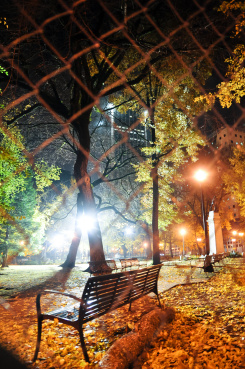
Approaching Chapman Square, I notice huge fences around the perimeter of all three blocks. To avoid stoplights, I decide to take a one-lap tour around the central Chapman park block. On this first revolution, I pass by two police officers in yellow jackets guarding the park.

“Passing on your left.” I announce, approaching them from behind. No response.

Peering through the chain-link fortress, my mind navigates nostalgically through the communal kitchen that once was, peering into the library tent where books and workshops were available. I float above the labyrinth of tents and tarps, the crazy eyes and animated conversations. My nostrils recall the filth and dirt, the panhandling parades of grime. Though I never slept a night there, I find myself curiously homesick for the void of such a raw, inclusive, community gathering-place.

After a full lap around Chapman, I begin a second. Then a third. How about 99 laps, to pay homage to the 99%? Quick arithmetic makes this task achievable in a few hours, so the decision is made.

Lap 15.

The night is serving dinner ice-cold. Older couples walk the streets after enjoying holiday performances downtown, holding each other close as the warmth from Shnitzer Hall flees quickly from their thick coats. I wonder how these elderly view the state of things. What inhabits the frontal lobes of such weathered minds, those having potentially experienced a World War, Nazism, nuclear deployment, the Great Depression, Korea, Vietnam, the Khmer Rouge, the civil and environmental movements of the 1960’s and 70′s? I become obsessed by all their eyes have seen and their hearts have navigated, while curious about their responses to the recent revolutionary surges.

I find this urban lap to be flat and uninspiring, as running repetitively around a 1/8-mile square of cement is demanding less on the body than on the mind. I begin to understand how such monotony offers some interesting meditations in movement. Sure, the unpredictability, irregularity and aesthetic of mountain foot travel are much more preferable, but I realize here that a flat road, track or even treadmill (yikes) certainly has some benefit, if only for cultivating mental fortitude. “Everything is practice.” To work on finding peace in rhythm, anywhere you are. 24-hour races. Sri Chimnoy’s 6 and 10-day Transcendent Races. Satish Kumar’s 8,000 mile walk protesting nuclear proliferation. My 99 laps certainly pale in comparison to such accomplishments, but I begin to understand the power of finding meaning in the monotonous.

Returning to breath, I continue.

Lap 33.

I have to pee. I take this opportunity to visit the Occupy Candlelight Vigil at City Hall, to ask where they go to relieve themselves. I find five street kids sitting with their dogs, bandanas and face tattoos, all laughing and smoking. Wary of a runner approaching them, their eyes wander to the Occupy patch pinned to my chest and tensions ease. Still confused.

“You guys know of a public bathroom around here?” I ask.

“Yah, there’s one in the parking garage,” the larger one responds. “Probably closed though, man. One about six blocks away that might be open, likely not though. Honestly, I would just hop in them bushes right there and go for it.”

Pudgy, greasy fingers point towards park bushes across the street, then he retreats quickly behind dark glasses. I strike up conversation with the others and mention my impromptu experiment of running 99 laps around Chapman tonight, paying tribute to civil disobedience and contemplating the future of this movement. They are barely impressed. As though my words had to first ricochet off nearby buildings to reach their ears, one guy finally responds:

“Shit, I may be able to run 99 feet!”

They all laugh and twitch nervously, and I join them. The laughing, not the twitching. I tell them my idea to complete 33 laps one way, then turn around and do 33 more the opposite direction, then a final 33 the original way, just to mix things up.

“Wait a damn second!” says another kid, cigarette limply parsed between cracked lips.

“Wouldn’t that be like only running 33 laps? ‘Cause once you turn round and run 33 the other direction, it’s like going backwards, like goin’ right back to zero. Then if ya turn round and do 33 the original way, your total laps run would only be 33!”

He was impressed by his math, and I equally amused by his imagination. The street kids wish me luck and promise me they’ll call 911 if they look over to see someone on the ground crawling or crying. I thank them for their kindness and cross the road to relieve myself, into the darkness of the park’s dying urban flora.

Then I return to my breath, and continue.

Lap 45.

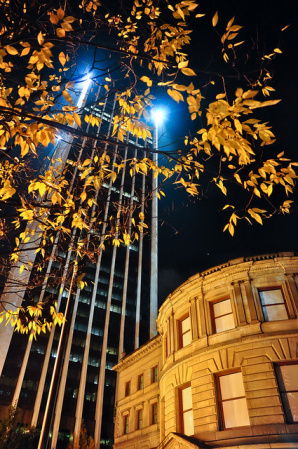
Fog infiltrates the city, shrouding the surrounding skyscrapers. The haze joins an eerie blue-green light on top of the Wells Fargo Building to create a severe laser beam effect, an authoritative eye scanning its subjects below.
The two young policemen return to again walk the parameter and, this time, I am running towards them. As I do, I catch one officer taking a glimpse of my Occupy patch. Finally! Only takes 50 laps to get some attention around here. Excited by an opportunity for dialogue, I begin to formulate an answer for any interrogation, but after passing them three additional times over the next five minutes, I realize they still have no interest in me. I however, develop an interest in them and, in each passing, I tap into their conversations, dominated by two topics: Girls and Music. One of the guards holds his head up to an iPhone blaring bad hip-hop to pass the time.

I realize here that, despite our glaring differences, the officers and I both share a common rhythm of repetition, monotony and humanity as we venture into this cold night of Mystery together.

Returning to breath, I continue.

Lap 66.
Over two hours circling Chapman Square, legs begin to feel heavy from the impact on unforgiving cement. I disrupt my urban orbit and begin running the opposite way for the last remaining 33 laps. It is 11pm and several policemen now filter out of Central Precinct for their night shifts, orange shotguns and riot gear in tow. To Serve and Protect Profits.

I wonder, despite some of the good work they most certainly do, why these policeman agree to blatantly suppress peaceful demonstrations which raise awareness for wealth inequality, corrupt banks and corporate interests running U.S. politics, all of which undoubtedly affect them? I try hard to cultivate empathy for the police, as Plato points me in the right direction:

“Be kind, for everyone you meet is fighting a hard battle.”

They too are good-natured humans, like us. Full of veins and brains. Blood and guts. Anxieties. Family or none. Victims of abuse. High cholesterol. Car payments. Mortgages. They could be full of love or empty entirely of it. Regardless of their personal narratives, I still expect them to inquire about whom they are actually serving and have the courage to reject such a blatant repression of expression.

Returning to breath, I continue.

Lap 80.
Low point. Tired of this cold, boring loop. Want to go home. Wondering why I decided to do this. No one cares. Nothing changes because of this, not that that was even the goal. What was the goal anyway? Right, to meditate on the current waves of civil unrest around the world. To pay homage to past efforts locally and contemplate new possibilities for the future. Our future. The human and the non-human. All of us. A recalibration of responsibility to stand up for what’s best for the Earth. To conduct a small, human-powered experiment of endurance for a bit more insight into our potential. Nearly three hours of running city squares begins to mirror the perseverance needed in our fight for global justice, trudging relentless forward through times of darkness and uncertainty.

I am reminded of the initial discomfort appended to any experience pregnant with change. Traveling from womb to world. Growing pains. Confronting an enemy. Moving past old relationships. Quitting a job to pursue your passion. Confronting death. Waking up to a system that’s required absolute submission and saying, “Nope. No way. Not anymore.” Dropping old habits, products that poison the Earth. Food and clothing produced from the sweat of the forgotten. Exploit Other. Exploit Earth. Exploit Yourself.

I gather this loose kindling and set it ablaze, regaining control of the fire that burns inside me. Any temptation dissolves to return home early, to feel silly for this experiment or wonder what anyone thinks as I complete my 90th revolution around Chapman. This contemplative exercise is for me, for everyone, for all things and for no one at all.

Resting blissfully in this realization, I return to my breath…and continue.

Lap 99.
Reaching the final lap, I playfully imagine something tripping me, a fleeing rodent or missing sidewalk chunk. Perhaps the sprinklers will turn on, signaling some celestial cheerleader applauding my effort. Maybe I’ll get speared by one of the officers dressed in yellow, clandestinely counting my laps only to foil the experiment at its last possible moment. Nothing so dramatic unfolds as I take four familiar lefts and make it back to my starting point.

Then I stop running.

With little hesitation, I find myself moving yet again, destined to complete one final loop for the remaining 1%. After all, no one is left out of this revolution. No one escapes the challenges we face. There’s no division. No Other. Just a floating vessel of blues and greens and browns, all traveling into the vast Mystery together. Together. Together. Together with the greedy CEOs and child sex offenders. Together with Chinese, Chileans and Canadians. Together with lovers and loathers, bodhisattvas and border patrol. Together with devastating earthquakes and radiant sunsets, great blue herons and scorpions, the Serengeti and the Sierra Nevada. To think our minds and hearts separate from anyone and everything is our Supreme Illusion. We are one singular unit making this work…or fail. A great revolving system taking deep, collective breaths together. Inhale. Exhale. Inhale. Exhale.

Fiercely empowered by this thought, the last lap feels like the first.

Hobbling the remaining 3 miles back home, I return hungry, tired and irritable. It’s past midnight when I get back. I plop into my chair after preparing a simple quesadilla and with zero ambition to process the evening, return to the womb of my warm bed, haggard and deeply satisfied with the effort.

The 99 Revolutions.

- Nicholas Triolo -

Photos by Igal Koshevoy
Posted in StoriesComments (0)

M1: A First Hand Account of the Heinous Crime of Jaywalking


Editors note: This story was orginally published in The Portland Occupier.

—-

Portland, OR - During the main May Day march, leaflets were being handed out calling for a Dance Dance Revolution – a roaming dance party that was to begin in the South Park Blocks. I arrived a little late to find about 100 protesters wrapping up the day’s activities with a celebratory dance party in Pioneer Square. The Bike Swarm had brought out the disco trike and was blasting dance music. We reveled in each other’s company, in song, dance and the spirit of revolution. Forming a conga line, we began snaking toward the justice center in order to bring some cheer to our comrades that had been beaten and arrested for the *gasp* inconceivable crime of jaywalking.

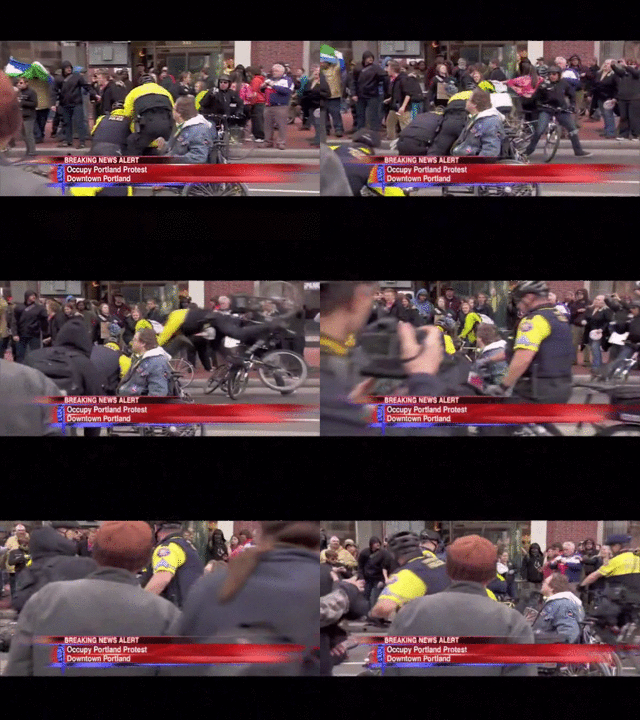
We crossed the street and I got about halfway down the block, when I turned around to see a gang of cops on bikes rounding the corner. They came pummeling into the crowd on the street. Cops and protesters went flying as they collided. One cop even flipped over another as they raged down the street and into the crowd. With fists-a-swinging, it’s like the police had taken our technique of bike swarming and used it against us in a cruel way. Following the flying attack pigs, there came the pigs on horses. The horses got up onto the sidewalk in an incomprehensible act of restraining protesters…onto the sidewalks…where they were already standing. Immediately, one of the horses emptied its bowels in fear onto the sidewalk. The horses, if asked what they thought of the situation, probably would have responded with “Why the hell are we being used as tools for evil?” That sentiment could probably be extended to the bicycles, if bicycles were sentient beings.

The cops dove into the crowd, grabbing protesters’ shirts, pants, legs, arms – whatever they could get their greasy paws on. Comrades were crushed by the gross weight of these beasts (and I’m not talking about horses). Because standing by and watching is how we got ourselves into this (much larger political mess), many reacted like they always do – with direct action! We grabbed our friends as they were tackled and pulled them back into safety and out of the grips of the Portland Industrial Police Complex. Based on the voraciousness of the attack, we wondered if there was some sort of dissent-crushing quota these pigs were trying to meet. We grabbed as many as we could, reassembled, and headed forward to the Jailhouse. The Disco Trike turned back. We couldn’t afford another $850 incident.

Songs and chants filled the air as we headed to the home sweet home of Chapman Park in order to let our friends inside know they were not alone. We lined ourselves up and down the sidewalk and faced off more bicycle cops, as well as a new battalion of black storm troopers. In times of stress, I sing to myself the imperial march from Star Wars. It seems to lighten the mood. After all, we are the resistance.

Choruses of “Solidarity Forever” were met with a light-flicking acknowledgement by those locked inside. Our megaphones carried the tunes of friendship up to the rafters. Echos bounced off the inJustice Center and probably rattled around freely in the skulls of the riot cops. I imagine there must be plenty of space in those heads of theirs – it’s doubtful that orders take up that much room. After each song, a choir of wolves would begin howling for the freedom of the members of their pack. Lights flickered in return. At one point, I got the chance to share my song with the Portland Police. It’s called “Cascadia, the Free“, and as I sang out to the riot cops, I hoped beyond hope that at least one line would penetrate their cold, black hearts and light a little fire of resistance.

-Little Bear-

Check out all our May Day coverage here.

Posted in StoriesComments (0)

About Last Night’s “Reoccupation” of Chapman Square


PORTLAND, OR-If you were watching at least one or two news stations last night, and if you’ve read the Oregonian‘s website this morning, you might have heard about an aborted attempt to “reoccupy” Chapman Square—the heart of last fall’s Occupy Portland encampment.

I was out there, too, showing up a little before 11 and staying until well-after the cops cleared the park’s sidewalks (no one messed with the still-tender, still-fenced-off replanted grass). And it was a strange affair. (And the Oregonian story, relying on a morning report from a police spokesman, got a few details wrong, mostly in timing.)

The occupation was impromptu, led by one occupier, Remi, who put the call out on social media for reinforcements in hopes of making a stand on First Amendment issues. He brought a sign, his molecular biology textbook, and a backpack. The idea was interesting: Occupy and break park curfew hours without camping—a protest, not a party, etc. Whether and how to reoccupy isn’t yet a clearcut issue for Occupy.

Editor’s Note: This story is excerpted from the Portland Mercury; you may continue reading here.

-Denis C. Theriault-

Posted in StoriesComments (0)

How Rose Found Her Roar


Editor’s Note: A version of this story originally appeared at the Portland Occupier.

Today it was my privilege to sit down with Rose and Pam Hogeweide at Anna Bananas in North Portland to discuss Rose’s arrest on the morning of Occupy Portland’s eviction. They are a dynamic and strong mother and daughter that I first met after seeing proud mother Pam’s Twitter posts announcing Rose’s first court date on December 13. They have been involved in Occupy Portland actions since October 6 and recently celebrated Rose’s 18th birthday in very Portland-like fashion with a tattoo that matches her mother’s.

I briefly visited with the family prior to court and we’ve kept in touch in social media circles. As was the case in many Occupy related arrests, Rose’s charges were dropped. By her account, this left Rose feeling very discouraged and ultimately dismissed, in the same way that she felt the entire Occupy movement was dismissed and disregarded. In the next 90 days, Rose actively participated in several actions, such as Occupy The Ports, with the full support of her family. Still feeling no sense of closure about the initial arrest, they decided that they needed to take further action and filed a complaint with the City of Portland. As a result of this complaint, earlier today [April 15, 2012] Rose participated in mediation with the officers who arrested her . She met with the pair of officers she was handed to after being pulled from the crowd in the following video around the 6:44-8:04 mark.

One of the most important questions Rose wanted answered was: why? Why her? She was 17, smaller than the protesters surrounding her, wearing a knitted hat in the shape of a lion, and as you can see from the video, was presenting no threat. Rose’s question initiated a tactical discussion in which she learned that she was arrested because she was in the “bubble”–the area defined by the supervisor standing behind the line of riot police. Anyone located in the bubble was subject to arrest, having supposedly been notified by the infamous “Ice Cream Truck” bearing the sound apparatus calling out a repeated warning to disperse. Rose stated she doesn’t remember hearing the dispersal warning and was suddenly being pushed forward right in the center of the line of scrimmage, in what was reported by officers as a somewhat tense situation. The police also told her that someone had thrown a water bottle or some small item, and that that was what began the series of arrests.

Simply put, Rose was arrested because she was there. She was detained for a short time, and asked a very reasonable question as she was being processed. She asked if she would still be able to attend college and one of the officers stated “this is Portland, this will help you get into college!” She was also told that she was “the nicest Occupier” they had ever arrested.

On that note, we discussed how her view of the political landscape has changed. She stated that prior to Occupy Portland, she wanted to go to college elsewhere, perhaps the east coast. She really had no thought or involvement in local or national politics. Pam stated that Occupy has caused a moment of enlightenment and a growth process in Rose and it is evident that she both supports and loves this awakening in her daughter. It is apparent to me that Rose began to Occupy as a child, and has emerged a more confident, self possessed and empowered young lady with a very bright future.

Through the past months, as Occupy has grown and progressed, Rose has learned that there is a method by which to express her feelings, and that there are solutions to the problems we all face. It has turned her into somewhat of a celebrity in her school, especially with her political science teacher, who looks to her for an opinion whenever Occupy is mentioned. She has gained a fierce sense of community pride and continues to demonstrate a civic consciousness that makes her mother’s eyes light up. Most importantly, she has found her voice and a sense of empowerment that will serve her well as she heads to Portland State University, to perhaps study political science.

-Angella Davis-

Posted in Stories, VideosComments (0)

Diane Emerson: Why I Occupy


Editor’s Note: A version of this story originally appeared at the Portland Occupier.

Seeking love and affection any way I could, I found myself pregnant at 15. Knowing I did not have the parenting skills necessary to raise a child, I gave her up for adoption. Then I went on a drive to prove to the world that I was a good human being. With no help from my family, I got myself through college, and, eventually, with the help of my husband, graduated with an MBA. My goal: to be vice president of a Fortune 500 company. Why? This was the ultimate measure of success for a woman in this country. I worked hard, stuffed my feelings far down into my soul, and started climbing the corporate ladder.

As I climbed, I noticed that the difference in pay between myself and the people reporting to me got bigger and bigger. This made no sense to me. These people were working just as hard as me, and had specialized skills I didn’t have. I couldn’t even DO some of their jobs! At one point I asked the human resources people if I could give some of my pay to my team. That suggestion was met with disbelief, and the response was that the HR department was working to increase the disparity, in order to provide people a greater incentive for for working their way up. I kept silent.

Eventually I reached the point where the VPs started inviting me to their homes on the weekends. I knew what that meant. They were seeing if I would fit into the tight social circle which exists at that level. I talked antiques and gardening with the wives, and golfing and global economics with their corporate husbands. I listened to them discuss their homes in Florida, their fishing and golfing trips, their travels to Europe and the Caribbean.

It became clear to me that they only socialized with others at their level within the corporation – tightly held in their carefully constructed bubble of safety and ignorance. I realized that if I actually reached my long-held and hard-fought goal, these people would be “my friends”, my social circle. It sickened me. I realized that if I actually reached my goal, I would be desperately unhappy, and would have to muzzle my voice and my life 24/7. I saw that the huge salaries were part of an ego game, to which everything was sacrificed. Nothing else mattered. I toyed with the idea of going along with the game, and changing the corporation from within. But I would have been alone in my efforts, and it would have been overwhelming.

So I quit. I quit the company, and ended up quitting my 20-year marriage and my country, and I moved to New Zealand to start a new life. I became an independent business consultant and focused on helping New Zealand entrepreneurs and small businesses succeed. Then 5 years ago, I moved into the gift economy – giving my time and skills to individuals and small nonprofits around the world who were dedicated to serving the poorest of the poor. I had no home, no car, and no worries. A year spent volunteering for people with disabilities in Kashmir, the most militarized place on earth, was the beginning of my activism.

Then, while volunteering for the Catholic Worker movement here in the US, Occupy was born. Now here was a cause that could handle everything I had to offer, and more. I had a plane ticket to take me back to Geneva in March 2012. I cancelled it. There is nowhere else on earth I can do the most good to help the world than right here in the U.S., in the heart of the beast. But this time I am not alone. I am surrounded with like-hearted people. Together, we will create the world we dream of. A world of acceptance, shared values, integrity, transparency, meaning, affection, love, and community. Everything I sought after since childhood is wrapped up in this package called Occupy.

-Diane Emerson-

Posted in StoriesComments (0)

Reverend Billy Discovers a New Variation of The People’s Mic


PORTLAND, OR - Last night I was speaking at Occupy Portland, and an inebriated individual was standing next to me suddenly, preaching a duet with me. I had to fight through my defensiveness. Finally I gave him the mic and he commenced a peoples’ history of the song “Amazing Grace” and then began to sing it, but couldn’t remember the words. People from the audience one by one walked up and each sang a phrase until the great song was completed… “was blind but now I see.” And we all whooped - it felt like a poignant variation on the peoples’ microphone.

-Reverend Billy-

Posted in StoriesComments (1)


Connect with us


Get Occupied Stories Monthly

A monthly round-up of [y]our best stories.

Where do our stories come from?


View Occupied Stories in a larger map