
Tag Archive | "n17"

Earth Evictions, Disaster Relief, and a Whole New World


When I first heard that earth eviction was the theme for the November 17th day of action, I was excited and a little saddened. I was excited because the day continues a push back against Wall Street we saw escalated by Occupy. “Wall Street is Drowning Us” would be our main theme. “Climate crisis = economic crisis.” Saddened because we have been pushed out so many times, sometimes by developers or the city, or today by planet itself.

Last year on N17, we planned a direct action on Wall Street. I was part of the shrub block.

We were part of the Liberty park which we had been kicked out of, finding our way into the streets throughout the city. “Kick us out the parks, we’ll take the streets,” we chanted throughout the rally. “Hey Bloomberg, Beware! Now Liberty Park is everywhere.”

Times Up! held a planning for this year’s N17 action at ABC No Rio. If earth eviction was the theme Times Up! would highlight a few of the other evictions which happen every day, especially in New York. Life here involves a constant process of navigating between spaces where we organize and build community, and the ongoing displacements, when we are forced to flee from spaces where we have slept and connected, which are just part of life in this neoliberal city. So, Times Up! organized an earth evictions ride in which we would revisit a few of these sites on the way to the N17 action beginning at the New York public library.

Riding over the action I stumbled upon police parked in bike lanes, as they texted and chatted. That these spaces represent opportunities for safety for riders seems to mean very little to them. The police are more than comfortable occupying community spaces, rendering them functionality useless. It is a phenomena taking place all over Brooklyn and New York.
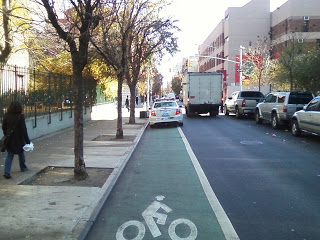
 Bikes parked on Hoyt and Stanton Streets, photos by B. Shepard

The earth eviction ride met at ABC No Rio, a squatted arts building on Rivington Street in the Lower East Side of Manhattan which has eluded eviction, though its been under constant threat. Riding up Avenue B, we passed East 7th St site of Esperanza Community Garden, a place where people shared space, a coffee, warm moments by a bon-fire during its eviction defense and subsequent bulldozing by the city in 2000.

Trees outside the Lower East Side Ecology Center were still suffering after branches has been ripped from them during the storm. Up Avenue B, we rode past Kate’s joint, a veggie dive which provided food for the encampment at Esperanza back in the day, before it finally shut its doors, a victim of high rights and changing times. Further up B we rode past Charas, a community center, and Chico Mendez, a garden. Both were spaces where Lower East Siders converged, battered about ideas, and exchanged resources before their subsequent evictions by the Giuliani administration. Spaces where we meet for cross class contact are always a threat to the powers that be. Over and over again, the neo-cons of the world dismantle “the institutions that promote communication between classes, and disguising [their] fears of cross-class contact as “family values.” Unless we overcome our fears and claim our “community of contact,” it is a picture that will be replayed in cities across America.” Spaces where we connect are always facing evictions. These evictions take multiple forms.

Today, it seems like the earth is evicting us. At least this is how it feels riding past the dislocated neighborhoods, ravaged by Sandy. Our ride continued past the Museum of Reclaimed Urban Spaces, whose basement was flooded by the storm. The museum’s opening was supposed to take place last weekend, but it is being pushed up to December 8th.

And of course, a year ago this week, we were evicted from Zuccotti Park, by the NYPD.

All these evictions zoomed through my head riding up to the NY Public Library for the N17 Earth Eviction Defense. Arriving at the NY Public Library, a mob of college students and members of Occupy the Pipeline were there to connect the dots between environmental struggles. Moving down the now sanitized 42nd street we staged a street theater performance outside of the JP Morgan Chase “to prevent the 1% from foreclosing on the planet,” noted the Tar Sands Blockade. “The Earth Eviction Defense is occurring ahead of UN climate talks in Doha this November. As the Kyoto Protocol expires this year, what happens at this gathering will have a long lasting impact on the future of the earth.”
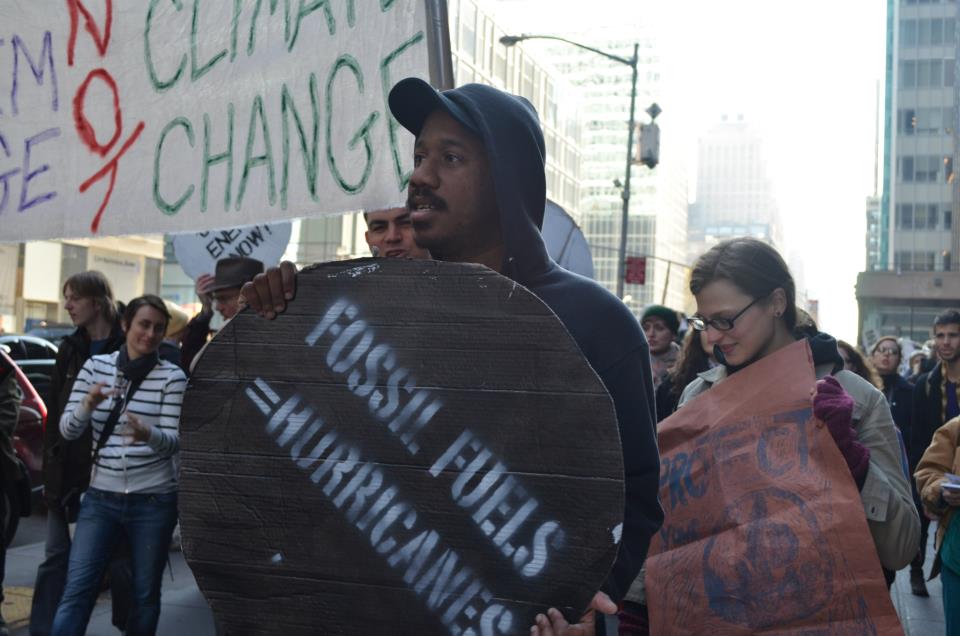
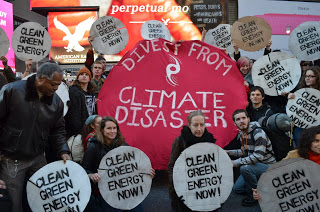
Scenes from N17. Photos by Stacy Lanyon

Photo by Stacy Lanyon

A central piece of this activism has recently involved the mutual aid networks expanding from those evicted from Zuccotti Park to the relief stations organized via Occupy Sandy in Staten Island and the Rockaways. My group, Times Up! has been organizing Fossil Fuel Disaster Relief Bike Rides to carry food and supplies from 520 Clinton Avenue to the Rockaways. In the days after the storm, cycling increased citywide, as cycling came to be seen as a solution to a myriad of problems. As the group’s press release explains:

Time’s Up Delivers Foods, Blankets, Bike-Powered Charging Stations, and Mobile Bike Repair to Neighborhood Devastated by Sandy.

The weekends of Nov 10th & Nov 18th Times Up! organized Fossil Fuel Disaster Relief bike rides to deliver food, blankets and other much-needed supplies, over 10 bike-powered charging stations, and mobile bike repair units to neighborhoods in the Rockaways devastated by Hurricane Sandy.

Using human power & their fleet of bike-trailers, cargo-bikes & baskets they picked up heavy loads of supplies from Occupy Sandy’s main distribution center at 520 Clinton Street in Brooklyn and cycled them over to the Drop-off center in the Rockaways run by Rockaway Taco & Veggie Island at 183 96th Street.

From there the volunteers distributed individual packages to home-ridden families in hard to reach areas, helped with clean-up, demolition and construction, and provided free bike repair and bicycle-generated power - sustainable solutions to the devastation caused by climate changed from the burning of fossil fuels.

The Time’s Up! energy bikes, used to generate bike power for OWS last year, will stay in the Rockaways to be used by the community as an alternative to the gas generators currently being used to charge devices operating only at 1% capacity and pollute the air we breath.

These rides highlight the need for relief not only from the immediate disaster, but also the root-cause of this disaster and others - the burning of fossil fuels.

Throughout the week, Keegan (a fellow Times Up! member) and I had talked about the similarities between Shakespeare’s Tempest and the efforts of Occupy Sandy. New York really was hit by a tempest. Yet, in response, we have started creating a new world based on care, mutual aid, and innovation. At Judson on Sunday, Michael Ellick suggested that such a world requires a framework for radical forgiveness of not only debts but of sins and personal flaws. It imagines creating a new form of ethics, something new of our social relations. It also requires care.

Arriving at the Times Up! space Peter Shapiro and Keegan greeted me. I said hello, introducing myself to a few of the other riders. One man worrying about his knees before the ride, when Peter chimed in that he needed not worry about he knees or feel like he needs to rush. Afterall, “even a crotchety guy” like him “could find this ride to be transformative” after he took part the previous week. The Rockaways are full of lovely oxygen, great air we can all enjoy. Air that will revitalize us, he explained. Throughout the trip from 99 S. to 520 Clinton Ave, we all talked, enjoyed the air, and the convivial social relations.

When we got there, we all enjoyed the mutual aid signs seem all over the church. Mutual aid is a different set expectations; it asks us all to share, to be fully human. It helps highlight who we are and can be. And most of all it is direct action.
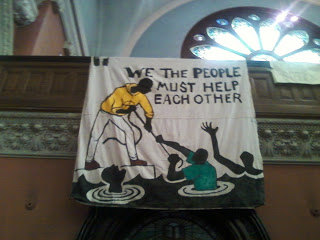
Signs and literature on mutual aid at 520 Clinton Ave.

Gandhi implored his followers to spin their own fabric in defiance of British colonial rule. In doing so, he suggested they could create their own power. Energy emanated from spinning their own clothes. “The spinning wheel represents to me the hope of the masses,” stated Gandhi. The same thing happens people powered energy, Times Up cycling events and energy bikes, recharging people’s phones, while sharing our lives with others. Through these rides, we divest ourselves from dependence on fossil fuels, while sharing what we have with others. The joyous rides, in which we pull trailers of supplies from 520 Clinton to Veggie Island, are our form of mutual aid.

“I just really enjoy it,” explained one of the riders. “You can’t say I am not getting something out of this.”

With these expanding mutual aid networks in mind, Alexandre Carvalho , of the Occupy Revolutionary Games Working Group, sent a post on “The #MutualAid network and the aftermath of #OccupySandy” to the September 17th list serve on November 19th.

I really see the advent of #OccupySandy as the beautiful religare to Occupy’s spirit of Zuccotti Park. a relational atmosphere that was missing from the scene in a while and is the cornerstone of what we do - a deep respect and solidarity with human beings in suffering, first and foremost. Meaningful movements have Lost Paradises, certain lost times, which serve as ethical compass for political dispositions. the park is our Paradise Lost. that eerie smooth human atmosphere that is at the core of what makes us human. The parks and streets and communities of the world are our roving Paradises - this time, Paradises that can be found and built together.

Aristotle once wrote that #poiesis is to “learn by making”. the new #Mutual Aid network of OWS should stay even after the destruction of the hurricane is over and done: there will always be natural disasters, and human-caused disasters to struggle side-by-side against, such as poverty, oppression, violence, environmental degradation, labor exploitation, injustice.

These silent daily disasters also need a hurricane of mutual aid. a grassroots #MutualAid arm, delivering direct [mutual aid] action from the people, by the people, to the people. seems to be the rebirth of OWS, from a political and ethical standpoint: always inviting and invited, respectful of differences, listening first and talking last, non-controlling or mass maneuvering, and above all making love the highest play.

if we are to have dogmas - and maybe we all need to believe in something… maybe the only one really worthwhile all along was love.”
Making his argument, Alexandre looked to the absurdist spirit of the Dada movement to suggest:
“MADA this,
MADA that
NADA this
DADA that!

Mutual Aid as Direct Action is a meme that wants to fly.”

Much of this spirit powered our ride down Bergen across Brooklyn on Flatbush to the Rockaways. “It was a wonderful ride,” noted my friend JC as we crossed the bridge to Jacob Riis, where piles of rubbage fill what was once a putt putt golf course. “That’s so telling of our culture,” mused JC. A peddi cab driver, he had taken part in our puppy pedal parade earlier in the spring. The rambunctious ride was enjoyed by kids, animal lovers and cyclists. “Love seemed to emanate from that ride,” he mused.

With piles of wreckage to the right and water to the left, we rode along the waterline down to Veggie Island at 96th Street. “The sea looks like it wants to run over the wall and up the street,” Keegan noted looking at the water lunging up to the sea wall. Rising sea levels are transforming the way we understand cities. And none of this phenomena is new. Cities such as Venice, Italy have been coping with rising sea levels for years now. New York’s waterfront has always been permeable. Battery Part was once a landfill from the World Trade Center. One day, the wreckage may be covered by sea once again.

“The earth does not have opinions. It just does what it does,” noted Peter, overlooking the piles or rubble.

“It looks like a third world country,” noted my friend Stephen, who lead the ride, as we arrived in Veggie Island. Piles of trash lined the streets, houses condemned, couches in the middle of the streets - scenes of Sandy along the waterfront. It was all so reminiscent of Katrina.

I dropped material off, turned around and rode back up Flatbush home, past Brooklyn’s neighborhoods, along the Botanical Garden, where yellow leaves line the sidewalk, once mighty trees coping without broken-off branches, open skies where there were once trees. Down Union Street my ride took me through Park Slope, across the Gowanus Canal, home and back to school to teach. It’s a good tired finishing a ride like this, a good tired of nearly forty miles connecting my life with larger movements of people, hopes, aspirations, tragedies, pleasures and anguish of a world far bigger than myself.
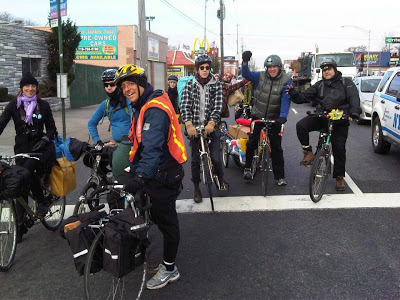
Photo by Juan Carlos Rodriguez

Posted in Occupy Sandy Stories, StoriesComments (1)

March on the Brooklyn Bridge


NEW YORK - My son and I arrived in lower Manhattan to march over the Brooklyn Bridge. We jumped into the line and marched slowly in a most peaceful crowd. This experience was life changing in a number of ways. In all my years of visiting New York, I have never been with such patient, kind and friendly people. There was absolutely no pushing or lude behavior of any kind which is wrongly expressed by Fox news. No one was drunk, unkind or out of control in any way. As we approached the top of the bridge, we had the good fortune of meeting Chris Hayes from MSNBC. He was very friendly and polite. We then met up with the mobile book library and donated several books in spite of the police taking over half of the library’s books while purging Zuchotti Park then not returning them. We arrived in Brooklyn to a great deal of celebration and just in time for the General Assembly meeting. Overall, by far the most enjoyable time in New York City in a very long time. We cannot wait to return!

-Maureen Purdue-

Posted in StoriesComments (0)

THE 99% BAT-SIGNAL: A Cry from the Heart of the World


A Man Named Hero

“Damn, man, I didn’t even get a chance to say my idea.”

“Shit, sorry dude,” I said. “What’s your idea?”

“A bat-signal, man. We need a bat-signal.”

“Bat-signal?”

“Yeah, like the Bat-Signal, but with 99% in the middle instead of the bat.”

His name was Hero, and we had just finished up a meeting, one of those long, disjointed, but somehow productive gatherings that you have far too many of when you’re trying to decide what the hell to do with 20,000 newly-minted revolutionaries on the two-month anniversary of the revolution.

It was complicated. We wanted to up the ante, in every respect, from the last big day of action that Occupy Wall Street (#ows) had pulled off on October 15. We wanted November 17 (or #N17 as it came to be known) to be more massive and more forceful. We wanted our actions to be in solidarity with organized labor, a very different animal than the decentralized, directly-democratic modus operandi of #ows. Some people were pushing hard for more radical tactics; others were stressing the need to reach out and bring more folks into the fold; yet others wanted to have a really cool birthday party. It was complicated. And we had very little time to figure it out.

In the end we decided to have three actions in one: “breakfast,” “lunch,” and “dinner.” “Breakfast”: civil disobedience in front of the New York Stock Exchange. “Lunch”: get out into the boroughs, tell stories, and bring more people into the movement. “Dinner”: that’s where Hero and I came in. Organized labor had already received a permit for a large rally in Foley Square. We needed an action that would allow a large and diverse group of people to be safe, while still showing labor’s commitment to fighting for jobs and against austerity, and that at the same time would celebrate the two-month birthday party for Occupy Wall Street in spectacular fashion.

We eventually settled on the idea of leading people out of Foley Square, around City Hall, and over the Brooklyn Bridge on the pedestrian walkway. It wasn’t an entirely popular choice, as many in #ows really wanted to take the roadway, as a reprise of the 700 arrests that had taken place there on October 1. Labor, too, was up for doing something more radical than a march across the bridge. The walkway was seen as too timid, too permitted. Ultimately, though, we came to a consensus: 99 union leaders, along with clergy and community members, would commit civil disobedience and take an arrest at the base of the bridge to demand jobs, while the remaining thousands would march across the bridge. It was up to us to turn that march into the most beautiful and compelling birthday spectacle possible.

First we decided to hand out 10,000 LED lights to the crowd as they encircled City Hall and went over the walkway, creating a “river of light.” The metaphor of light was important. The Occupy movement is shining a bright and piercing light on a political and economic system that is fundamentally corrupt and malignant; a system whereby our democracy has been purchased outright by corporate money and is being held captive to private interests. We wanted the “birthday party” to be a celebration of our commitment to shining a light on these and other injustices. But we needed more than LEDs.

The meeting broke up. Hero still had his hand in the air. He turned to me.

“A bat-signal, man. We need a bat-signal.”

“You’re right Hero, it’s genius. I’ll do it.”

It really is genius. For one, it’s accessible. The Bat-Signal is a part of our visual commons, part of the “spectacular vernacular” of global pop culture. No translation necessary. And what does it symbolize? It’s both a call for aid and a call to arms. Help! and Assemble!—it means both of these things. And isn’t that precisely what the Occupy movement is? Are we not, in our choice to stand up and take action on behalf of the 99%, a call for aid and a call to arms? Now, of course, Batman is actually a quasi-sociopathic millionaire-vigilante. A one-percenter, you might say. But by filling that symbol—by occupying it, with our own content: the 99%—we appropriate it for all of us. And in this reconfiguration, we are no longer waiting for some superhero to come in and save the day, whether it be a masked vigilante or the first black president. In this telling, we are the response to our own call for aid. We aren’t waiting for Batman or Superman—we are going to get to work and begin the process of saving ourselves. Genius.

A Woman Named Denise

There was no question where we were going to project our bat-signal: that massive urban eyesore, the monolithic slab of windowless concrete commonly known as the “Verizon Building.” A windowless expanse of concrete approximately 75 feet wide, low ambient light, with a clean line of sight from the Brooklyn Bridge? Really? The thing nearly begs for it. And Verizon, which has been screwing its workers ever harder over the years, has been begging for it, too. We knew that thousands of those workers—members of the Communication Workers of America—would be marching with us that day over the bridge. The light show would be especially meaningful to them.

I’m no projection artist, however. How the hell were we going to get the projection up there? And what about projections on the bridge itself? We needed those too. And how about some Graffiti Research Lab-inspired Laser Tag, like the one Free Tibet protesters used in Beijing during the 2008 Olympics? Let’s get that going too. It was getting complicated, and I’d need a lot of help. One of the benefits of working on behalf of a popular uprising is that people want to help out. I had to make a lot of phone calls, but pretty much everyone I called was eager to say yes to helping out Occupy Wall Street. A mobile projection unit team was assembled, with all the necessary batteries, power inverters, mobile video players, etcetera. Taylor Kuffner stepped up to lead that team. The laser tag crew was headed up by Nick Gulotta, a Students for a Free Tibet activist who was familiar with that mysterious technology. I would head up the bat-signal squad. The first thing I’d need was a projector—the stronger, the better. I had a friend and I made the call. Sure, he said, we could borrow the 12,000 lumen projector if we had somewhere safe to project from. Ah yes. A safe space to project from. Now, where were we going to find that?

In the shadow of that hideous, 32-story corporate monolith are the Alfred E. Smith Houses, a group of 12 buildings 15 – 17 stories high. City housing projects, home to thousands of low-income tenants. The closest of the buildings is a mere 135 feet away (I measured). It’s like they’re living in the shadow of Mordor, or Saruman’s Black Tower or something. Surreal.

I put up signs (offering $250 to rent an apartment with views for a film project) in the lobby of the closest couple of buildings, as well as the hallways and stairwells and elevators, and I waited. Over the course of the next two days I received three phone calls, none of them remotely what I was looking for. They had misread the sign. They didn’t live in the building. They lived on the fifth floor. I was beginning to think I’d wind up lurking the top stories until I cornered someone, when I got a call that made sense. She lived on the 16th floor. She could do it on November 17. She had views that I needed. I went to meet her later that day. Her name was Denise, and she worked for FedEx. She had three daughters. She was born and raised in the building. When I told her what we were actually doing, and why—for Occupy Wall Street, for the 99%—I saw her eyes light up. “Yeah, really? That’s so great, what you guys are doing is so great.” Her parting words to me that day were “Let’s do this!”

A few days later I was scrambling around trying to get Denise the money to pay her up front. It was Tuesday, the day that #ows was evicted from Liberty Square. It was a long hard day, and things were pretty chaotic. On top of everything else, the finance committee was nowhere to be found, and so I couldn’t get Denise the money I’d promised her. I felt pretty low when I finally reached her by phone around 9:00 and tried to apologize, but she wouldn’t hear any of it. “Honey, don’t you worry about that. This ain’t about the money. I watch the news. I know what’s goin’ on. I can’t take any money for this. This is for the people. We’re gonna do this for the people.”

I thanked her, hung up the phone, and wept.

Mic Check!

Things were looking good for Thursday, but as I continued to contemplate the whole project and scouted the scene more and more, the scale at which we’d be working began to dawn on me, and additional possibilities began to seem … possible. I wondered if we might even be able to get the crowd to interact with the messages that we’d be projecting. Could we utilize the “human microphone” idea through text and get the crowd to “mic check” what we projected? It was worth a shot, I thought, so I wrote a brief statement:

Mic Check! Mic Check! Mic Check!
Look around
You are a part
of a Global Uprising
We are a Cry
from the Heart
of the World
We are Unstoppable
Another World
is Possible
Happy Birthday
#occupy movement

The night before the action, I worked on the graphics with Max Nova, who had given yet another example of a full-throated yes. He came up with some additional text elements, like “Love” and “Do Not Be Afraid,” that would make the evening all the more beautiful. I tossed in some familiars like “We are winning,” and “It is the beginning of the beginning,” which is my personal favorite cardboard sign of the entire Occupation. Max stayed up all night developing the various elements, and his partner JR manned the VJ controls from our little “Oz Booth” in Denise’s bedroom.

I didn’t expect to be able to hear the crowd from the apartment. I sat in the window, where I could listen to them roar, chant, and read that statement over and over again. Each time they called out, “You are a part of a global uprising,” we had to pause to allow them to roar their hearts out. It was amazing; it was magic. We projected from up there for a full hour and a half, uninterrupted.
“We are a cry from the heart of the world”—those are my words. That’s what it feels like to me. We face such immense challenges, such urgent crises, sometimes it seems that there’s no way out, no path towards a brighter future. The crises are political, social, economic, and environmental, all at once. Together they threaten our very existence as a species, and the existence of many other species of life on the planet. What’s happening today feels to me like the immunological response of the species, or even of the planet, rising up to save itself. I am extremely grateful that the immune systems are still functional, that we carry within us this profound reverence for, and desire to serve, Life. To set things right, to fight off the pathogen that is “the order of the world that we have inherited, that has come down upon us and which at this moment is called Capitalism” (Peter Schumann), will require nothing less than a global uprising, a cry from the heart of the world, and I think that we are finally beginning to hear it.

Coming to an Edifice of Power near You

The laser tag crew got the worst of it. Arrested before they even really got started, for trespassing on a roof. Twenty-six hours in jail. The mobile projection units were able to project onto the State Supreme Court building in Foley Square, and got interviewed by Mother Jones, “Democracy Now!” and others. The 99% Bat-Signal? It blew up on Twitter, which led to Xeni Jardin interviewing me for Boing Boing, which led to an appearance on Rachel Maddow, an A.P. story, a shout-out from Jimmy Breslin in the Daily News, a viral video, etcetera. In both old and new media, we had our five minutes of fame.

Within a couple of days we’d been contacted by occupiers in Los Angeles, Boston, Boulder, and Cleveland, with more each day, all wanting to get their hands on the graphics, particularly the Bat-Signal itself. They wanted to project it using whatever means they had at their disposal, at targets of their own choosing, for their own reasons. It looks like #N17 was just the premiere of what may be a long run. Someday the 99% Bat-Signal may even become as universally recognized as the original. For now, look for it wherever you are, and when you see it blinking there in the dark, consider answering that call: for aid, to arms, and to join in the cry from the heart of the world that is the Occupy movement. Save us. Save yourself. Save the Earth. You are the 99%.

-MARK READ
Originally posted in The Brooklyn Rail, posted here with permission from the author.

Posted in StoriesComments (0)

November 17th Brooklyn Bridge March


Like many people I was disgusted by the Zuccotti Park raid that took place Tuesday morning. So when I heard about the Brooklyn Bridge march on Thursday night I felt compelled to act. I was impressed by how many people came out to show their support at this critical point in the movement. But what really caught my attention was the overwhelmingly positive reaction we received from the drivers on the Brooklyn Bridge. In a spontaneous gesture of solidarity hundreds of drivers slowed down, honked their horns, waved their fist in the air and cheered us on. I imagine the last thing many of them heard about Occupy Wall Street was the nationwide crackdown that culminated in the Zuccotti Park raid. Many may have assumed that would be the end of the movement. For those, I believe it was especially important and uplifting to see thousands of people from all walks of like marching in defiance of brutality and in support of social change for a better society. And this all took place in view of an amazing guerrila light show on the Verizon building. It was quite a galvanizing moment.

(((video from the bridge)))http://www.youtube.com/embed/-ZL27BXh_AU


-Tate Harmon-


Posted in StoriesComments (0)

Report Back: Shut Down Wall Street


NEW YORK - This morning I woke up before dawn and rode the subway downtown. By 7:00 am there were hundreds gathered two blocks north of Wall Street, across from Liberty Plaza and every minute the crowd grew. There was a massive police presence and lines of helmeted officers blocked us from advancing south, so groups of a few hundred each started marching east. The police had frozen a large area around the stock exchange and set up checkpoints at each entrance, closing off public roads and sidewalks. If you had a political opinion, you could not enter.

We gathered at each chokepoint and we took the streets. People locked arms in long lines across the street and stopped the workers heading to Wall Street. Over the next few hours, as I wandered through the streets, every intersection toward Wall Street that I saw was jammed with people. The police would periodically push through and open a corridor, letting workers with badges pass, and we would periodically close it again. Some of the people passing through nodded their heads and smiled at us, others yelled and cursed, and a few brave ones stopped to talk. At one point, to clear the intersection, police held up metal barricades and charged into the crowd, knocking people to the ground, rushing past them, then arresting them.

At 11 am many people left the intersections downtown and gathered in Liberty Plaza, which was surrounded by police and metal barricades zip-tied together. They were only letting people in and out through one of two entrance’s and checking them as they went. Much of the crowd gathered outside, reluctant to enter the pen. Then a small group pulled the barricades apart at one section and a crowd flowed toward them to help. Within minutes an entire wall was down and the barricades were piled in the center of the park. It was amazing.

Back into the streets for me, there’s still a whole lot of action before this day ends.

-John Dennehy-

Posted in StoriesComments (0)


Connect with us


Get Occupied Stories Monthly

A monthly round-up of [y]our best stories.

Where do our stories come from?


View Occupied Stories in a larger map