New York, NY – Yesterday I woke up before dawn and headed down to the financial district to celebrate one year of Occupy Wall Street. I met some friends at the assembly point for the Debt Zone and set off with the group to confront the police cordon around the Stock Exchange. We spilled into the street and briefly formed a wall in front of the barricades but police immediately moved in, made arrests and pushed us onto the sidewalks or down the street. Police blocked streets and formed moving lines around us and we retreated back to the assembly point to regroup and splinter into smaller groups.
From there I joined some friends and walked toward Wall St. once more. There was a group of protesters on either side off Broadway near Wall Street, mixing with business men and women heading to work. There were police horses behind the barricades, lots of police in the street and police cars and prisoner transport buses parked. When I stepped off the curb into the crosswalk during a chant of “Whose Streets? Our Streets!” I must have caught the attention of one of the white shirts. When it became clear that even with the red light I would not be able to cross I returned to the sidewalk but I saw a white shirt point at me to a new line of police that had just arrived. I tapped my friends on the shoulder and said, “I have to go, I think the police are targeting me.” With that I felt someone grab my arm and pull me toward the street but I was able to jerk free and duck under some scaffolding. I ran a few seconds before a large man stepped in front of me, blocked my path and gave me what amounted to big bear hug. I assume this man was an undercover police officer. Within seconds uniformed police that had pushed through the crowd, forced me against the metal scaffolding and tightened cuffs around my wrists.
They walked me onto the police bus where I had a front row seat to watch some clergy sit down in front of Wall Street in an act of civil disobedience. When the police crammed thirty of us into a holding cell, our cuffs still on and increasingly painful as blood collected in our hands, swelling them against the hard plastic rings, an 81-year old priest I had watched lay down at the foot of financial power led us in song. “I’d like to share some freedom songs I first sang with Martin Luther King in the jailhouse of Selma, Alabama,” he said. We sang songs, the dozen women in the holding cell across from us joining in. Our voices pushed out beyond the bars, and we alternated singing with mic-checks and soapboxing why we choose to join the movement. The 81 year-old priest then mic-checked a message to the police, dozens of whom clogged the space between our cells. I cannot quote the words but clearly remember the meaning and emotion: We are all brothers and sisters in this struggle and I urge you to see us as allies in a common cause rather than enemies. We each repeated his eloquent words and I could see a burly police officer directly in front me nodding his head. At the close, he looked at the priest and placed his hand on his heart. It sent chills through my body.
Finally, my name was called, my cuffs cut, my person searched then led to an even larger holding cell. When I walked in I saw about one hundred people pressed together between bars and reinforced glass, sitting on wooden benches, lying on the concrete floor and standing in the spaces in-between. All of them were clapping. As each new prisoner was added to our cell, we clapped. We clapped when each female was lead past us to the women’s cells. There was a non-stop flow of cheer. The holding cell had been self-organized into a very crowded section against the cell door that was loud and boisterous, while at the far end near the two metal toilets was quieter and some people lay on the benches or floor, using their shoes as a pillow. Within the louder section there was also a small General Assembly that formed where people shared their arrest experiences and discussed tactics. Every few minutes as new prisoners were added we heard new tales from the outside: We shut down a Chase Bank; I was plucked off the sidewalk for no reason; we blocked the doors at Goldman Sachs; I was trying to take pictures of an arrest when they grabbed me; etc. etc. At various points some prisoners grabbed garbage cans or water jugs and started drumming. Everyone else quickly picked up the rhythm clapping their hands or banging on benches, walls and metals bars and a hundred of us made music together before the police stormed in and took away the makeshift drums. The time between the noises we made together were filled with hundreds of subversive conversations.
It was wonderful. Each time I heard a new story of the actions taking place on the street after I was picked up I felt like I was missing something; but I also knew the community we formed in our cells was one of the most incredible things that would happen all day; one of the most liberating things I would ever feel. I knew that just by going out with Occupy Wall Street I was risking arrest; and in fact that was a major motivation in coming out, to show that I will not be intimidated, to count my body among the opposition. The power of the system is never so naked as when it forces it’s dissenters into a metal cage. Only then does it become so transparent and so obvious that they will never control my actions, that they will never control my thoughts and suppress my hope for a different world, a better world.
When I was released, nine hours after I was detained, a group of friends were waiting for me with food and love, thus completing the experience and ending it with warmth and inspiration rather than fear. Yesterday, I was free.
Denver, CO-On Sunday July 29, Occupy Denver marched to support the citizens of Anaheim, CA in their ongoing resistance against their city’s violent and racist police force. This action brought attention to recent police atrocities in Anaheim, and served as a reminder that Denver’s own police department is essentially a taxpayer-funded street gang with a detailed history of murders, racist beatings, and political repression. (See the links at the bottom for documented cases of Denver Police atrocities.)
Here is my personal account of my participation in the march and my false arrest by DPD:
I arrived at the march as it staged outside the skate park. I had my bicycle with me, and rode my bicycle throughout the march, mostly because biking requires less energy than walking. The march took the streets and went under the underpass by the Rockies stadium as we made our way downtown. We unfurled our banner reading “Stop Police Oppression– Solidarity with Anaheim” and chanted phrases such as “Justice for Anaheim”, “We want equality, stop police brutality” and “How do you spell injustice? DPD!”. At least four DPD vehicles began following us at this point, and they blared their sirens in an unsuccessful attempt to keep the game day crowd from hearing our message. The leading DPD vehicle was an SUV driven by one William J Andrejasich Jr, a Sergeant in DPD’s Special Events division.
We made our way to the downtown area of Denver, and Sergeant Andrejasich and his colleagues repeatedly attempted to use their voices and vehicles to discourage the march from keeping its message in the street. DPD prefers to see political expression confined to the narrow sidewalk where it cannot affect business as usual. This march had other ideas. I myself chose to remain on my bicycle in the street, as riding my bicycle on the sidewalk would be a violation of traffic laws and DPD will use any excuse to harass and arrest known Occupy activists.
The march continued down the 16th street mall as we continued to agitate and inform the public about the police murders and subsequent attacks on residents in Anaheim. Our police escort continued to ride very close to us until we arrived at Civic Center Park. After the police caravan departed, we decided to resume marching. We made our way through Lincoln Park and began marching past the Capitol on Colfax Ave.
As the march approached the intersection of Colfax and Pennsylvania, several DPD vehicles pulled into the middle of the street and officers stepped out of the vehicles. Sensing that DPD was looking for a fight, the march diverted onto the sidewalk. At this point, three officers charged our “Stop Police Oppression” banner, one of them striking it so as to break the wooden support pole holding it together. After breaking the banner (which appeared to be the primary target), the officers proceeded to grab and arrest the protester who had been using the megaphone to decry police violence throughout the march. They led him away into a car, and Sergeant Andrejasich barked at us that “if you go in the street again, we will arrest you.” This threat seemed absurd given that whenever we march, DPD’s vehicles that follow us essentially shut down traffic anyway. Sergeant Andrejasich was clearly hoping that by threatening arrest and possible violence, he could frighten our solidarity march into giving up and going home. He should know by now that Occupy Denver doesn’t play like that. Having seen DPD use violence or the threat of violence countless times to attempt to silence dissent, I figured someone should resolve Sergeant Andrejasich’s confusion about the relationship between his department and our subversive assembly. Using the megaphone dropped during the recent arrest, I told him that “Occupy Denver does not negotiate with terrorists, and the Denver Police Department is a terrorist organization.” Upon hearing this, Sergeant Andrejasich instantly went red in the face and grabbed my wrist, at which point he and another officer pulled me into the street, and while holding my wrists attempted to twist my arms into a painful position (I have a sprained wrist and was wearing a splint). I was handcuffed, and when I asked Sergeant Andrejasich why I was being arrested, he replied “for obstructing the street.” I told him that I was legally on my bicycle for the entire march route and he said nothing in reply to this. He then handed me off to two other officers who placed me in a car and took me to DPD’s offices in the Downtown Denver Detention Center. Interestingly, Sergeant Andrejasich is not listed as my arresting officer, and none of my arrest paperwork contains any of his information. We only know it was him due to his past interactions with our group. Before I was processed into the jail, I sat in a DPD District 6 cell while I listened to three officers outside the cell flip through the book deciding what to charge me with, highlighting the fact that this was a false, politically-motivated arrest. Upon being booked into the jail, I was informed that the megaphone I used had been confiscated by the police, presumably as “evidence” of my obstructing the street.
Two more arbitrary arrests of protesters were made after my own; during one of these arrests a ten-year-old child was forcefully knocked to the ground by one of the arresting officers. The march continued well after my arrest, culminating in a heated standoff between the remaining protesters and a heavily armed line of officers outside DPD’s District 6 headquarters as the march chanted “free our friends” and continued to hurl passionate criticism at Denver’s corrupt, racist, and violent police force.
After the march subsided, a group of occupiers gathered outside the jail awaiting the release of myself and my arrested comrades. Sergeant Andrejasich again approached this group, and told them that they were creating a disturbance (even though they were being quiet) and that as a warning had already been issued to the group, he could arrest any of them at any time with no further warning. Sergeant Andrejasich seems to believe that he can operate with impunity, arresting activists simply because they irritate him or offend his political views even when no laws are broken.
Sergeant Andrejasich’s comic arrogance represents DPD’s belief that they have the sole power to decide who is breaking the law and have the right to choose when to selectively enforce these laws. Everybody knows that jaywalking is common practice in Denver; one can jaywalk in front of a police officer without any fear of reprisal. However, when one is walking in the street as part of a radical political march, DPD suddenly decides these laws are worth enforcing with great zeal and armed force. Occupy Denver rejects the Denver Police Department’s twisted, politically selective interpretation of municipal codes, and we reject their claim that they protect and serve the citizens of this city. Their long record of murders, racist beatings, and politically-motivated violence makes their moral depravity obvious to anyone who is paying attention. We call on the City of Denver to condemn this corrupt and criminal police department, and to take their destinies and the safety of their communities into their own hands.
Our Anaheim Solidarity march was just one small part of the struggle against police oppression in Denver. There is a long history of resistance against police oppression in Denver, and this resistance is ongoing. We encourage everybody to attend the upcoming March Against Police Terror, which meets on August 21st at 6 PM in La Alma Park (13th & Mariposa). More information on this important community event can be found here:
Here is a short list of news stories related to Denver Police atrocities outside of their attacks on Occupy
Denver:
Recent murder by DPD
DPD murdered an innocent man last summer, the murdering officers faced no consequences
In 2009, DPD officers beat a man within an inch of his life while yelling racial slurs at him
DPD recently reinstated, with back pay, two officers involved in the infamous Denver Diner beating
In 2010, Denver Sheriffs tased a man to death in the Denver jail simply because he would not take off
his shoes. All officers involved were cleared of wrongdoing.
Editor’s note: This story originally appeared on the author’s Facebook and at the Occupy Austin website.
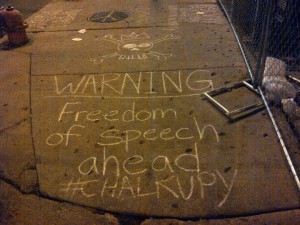
Austin, TX-On Thursday, August 9, I took my two children, ages 4 and 7, to an Occupy Austin event called “Chalkupy the World.” Many other cities around the country, and even abroad, participated in this event. I’ve been to a few Occupy events, support the methods and messages of Occupy, and am somewhat active in one of the Occupy groups that does work dealing with the local school district. The Chalkupy event was supposed to be a gathering of people using sidewalk chalk to express, well, anything really, but mostly dissent or disenchantment with the way things in our country have evolved to either favor the ultra-wealthy or punish the poor, middleclass, marginalized, or otherwise “different” people.
I anticipated that this was going to be a small event, and one that would allow me to show my support of the Occupy movement while also letting my children participate, or at least keep them occupied. They like chalk; they like to draw. I wasn’t really expecting police intervention. I’m a responsible mother; I would never knowingly put my children in harm’s way. I thought, particularly in Austin, this event would be reasonably innocuous. But I’m also responsible enough to want to teach my children to participate in the citizenry, to stand up for what they believe in. I can’t say I’m altogether surprised at what happened, which is really a sad comment on our society.
I took my children because I thought it was an appropriate place for children to participate in coming together, in citizens who don’t know each other meeting in person, in public space…in space that is for the public. I think it’s worth mentioning, too, that the day before, I had just read William F. Buckley Jr.’s essay “Why Don’t We Complain?” Writing in 1960, the famous conservative commenter remarked on how much people at the time were willing sit back without remark and endure unreasonable situations. He explains that it’s sometimes complex, that there are often hidden reasons for why some things are the way they are. But his essay challenged me. And on August 9, I was feeling a duty to myself and my country to speak up for things that seem unjust. If I didn’t, who would? How would my children learn to speak out against injustice?
We had picked up two packages of giant-sized sidewalk chalk earlier in the afternoon. They were the biggest chalk sticks I had ever seen, and I found their cartoonish proportions a little humorous. Two sticks in each pack. Two sticks for each child. I knew there would be more chalk waiting at the event, but it’s always good to come prepared. As we drove to the event, I reminded my children they could draw anything they wanted. I want my kids to participate in the public sphere, but I don’t want to be too heavy handed in what messages they feel forced to repeat. They will change their minds about many issues many times as they grow. I don’t think I need to force them to accept any point of view right now. I did tell them, though, that they might want to think for a minute about one thing they thought would help make the world a better place. My younger child thought about rain. My older child mentioned recycling. I told them that would be great, and that they could draw as many pictures as they liked.
When we arrived, there were about 10 Occupiers on the southwest corner of 11th and Congress, just across the street from the Capitol, where Occupiers had been warned not to use chalk. But we were all on public property on this corner. We noted the large box of sidewalk chalk on the bus stop bench. It had many more color options available. So both of the children picked out a couple of colors. My son, my older child, set in on his design. He decided that drawing the earth in a “recycling triangle” would be good. My daughter started drawing butterflies. She’s just recently developed the skill of representation, so her drawings are actually starting to look like something. I wrote a message about how I would be better off financially had I never decided to pursue graduate studies.
This is true, by the way. I would have been earning a middle class income from the time I graduated college in 1997 through today. I wouldn’t have any debt. In fact, in my one year working in a corporate office after I earned my bachelor degree, I saved over $7000 dollars. I’m pretty thrifty with money. I would not have had to take out student loans (all subsidized), and I wouldn’t have had to live on the approximately $800 monthly most graduate assistants make. Of course, I would not have become more educated about history, philosophy, justice, and education. It makes a difference in your perspective. It’s important to remember that education is not a commodity. I don’t owe money for student loans because I wanted a boat or an expensive purse. I owe money because I wanted to be an educated citizen. I thought that was a responsible decision. I’m still waiting for someone to tell me it would have been more responsible to keep my office job and keep my mouth shut.
The adults had already noticed the group of state troopers gathering across the street in front of the Capitol. Apparently, one was also hiding in a car across Congress. Whatever the case or the number of eyes, four troopers crossed 11th Street over to our corner. They promptly arrested two adults who had been chalking. One of the arrested chalkupiers was wearing a mask covering his face. When my children and I first arrived, they asked about the mask. I simply explained that some people like to be private. They accepted this answer without further inquiry. Indeed, children are often at ease when their parents or role models help make sense of the world for them and are honest with them about what they see. That’s not always a very easy task. Taking a moment to consider one’s response and how it will potentially frame the world for children does take a little more effort at times, but I’d rather not go around dividing the world up into “people like us” and “people not like us” for my children. I imagine there are parents who would have explained that the young man with a mask was just weird, wanted attention, thought highly of himself, whatever excuse they could use to make sure that their children understood that he was “different” and that “we” don’t act like that.
When the troopers came to our chalking area, my children were frightened. My son began to cry. He’s pretty sensitive, but very logical. My daughter feigned crying to be like her big brother. She’s big on drama and intensity. She has asked me to recount the story of the time I stepped on a nail when I was 12 years old a thousand times, but she’s not given to crying, unless someone else has tried to pick out her outfit for the day. Without any warning, the troopers arrested two chalkupiers. I approached one of the arresting officers and politely asked if he could help me understand why two people were being arrested. He deferred to the other who explained that chalking public property was considered criminal mischief. I asked if it was explicit in the penal code, if the code was specific in naming the use chalk on public property as criminal mischief. He explained that no, but it could be considered such.
Let us remember, too, that a number of courts have upheld citizens’ use of chalk as a form of expression. The Ninth Circuit Court of Appeals wrote, “No reasonable person could think that writing with chalk could damage a sidewalk.” (Mackinney v. Nielsen 69 F.3d 1002, 1995). To make this absolutely clear, in our country, we have freedom of speech to protect unpopular speech. This does not, however, protect use of dangerous or slanderous speech. We all know that we may not use words to threaten another or incite violence. That kind of speech is not protected. Similarly, had there been threatening messages or even obscene drawings, that use of chalk might reasonably be considered mischievous. But there were no such messages or drawings, only messages of dissent and drawings of the earth and butterflies.
After the troopers took the arrestees across the street, I calmly gathered my children and started toward the car. I certainly did not want to keep them in a place where they might be subject to violence or see their mother arrested for chalking. They were both teary. We walked for a minute. Then, I literally asked my children to stop for a moment while I thought. As a parent, you really have to do this sometimes. Sometimes, you have to stop and figure out what is best. If we left at that moment, what lesson were they going to learn? What meaning would they make of what just happened? Of course we were going to be discussing this at length; that goes without saying. But what would they take away from this event if, having told them it was not right for the police to arrest those two people, I simply walked away, too. I knew, already, I wasn’t going to go back to the chalking corner. So I simply turned around, crossed 11th Street to the Capitol, and I told my children I wanted to talk to the troopers, to see if I could understand what was going on.
Now, I’m an adult who (not that it’s anybody’s business) has never been arrested. And that might even be a damning statement against me, depending on who you’re asking. Because, without doubt, there is injustice in our country. We have one of the highest rates of childhood poverty in the “developed” world; we have the least amount of access to health care in the “developed” world; we don’t let consenting adults of the same sex enjoy basic civil liberties; we allow bankers who stole millions of dollars to continue their practices without so much as an investigation. These are surely injustices. Don’t get me wrong, I am thankful we live in a country where women are allowed to obtain an education; I am thankful our country attempts to educate every child, whether poor or rich; I am thankful for many things. But that does not absolve me from my duty to make this country better for the vast majority of people. What I’m stalling in admitting here is that talking to police makes me nervous. Which is a shame. At any rate, I had an example to set for my children. Children should learn to speak respectfully to officers of the law; they should be willing to approach one if it seems that something wrong has happened. And as a mother, I honestly did not want to walk away from this with children frightened of a police officer who might be trying to help them if they were lost or if there were an emergency such as a fire.
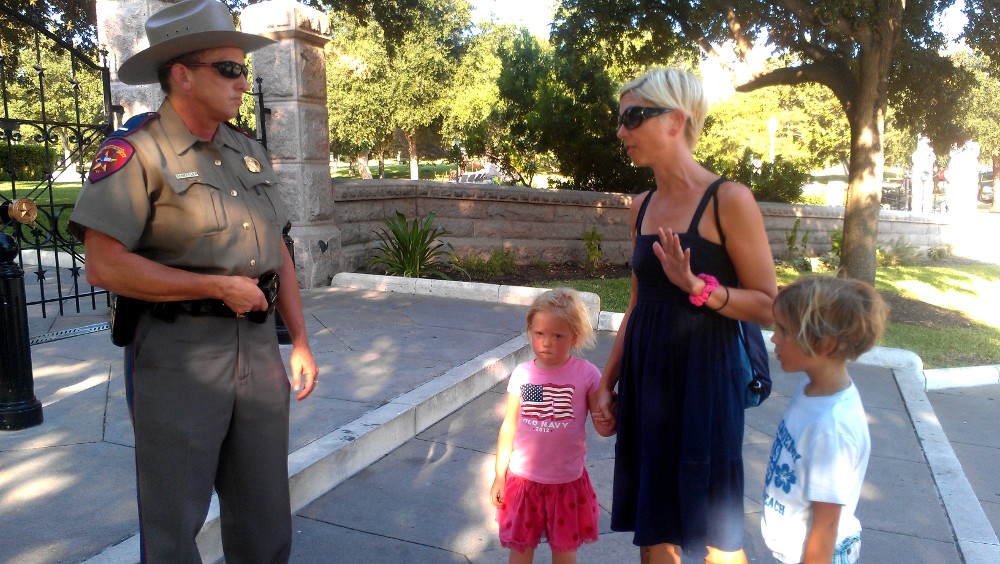
Hillary Procknow confronts a State Trooper about chalk arrests. August 9, 2012. Photo: Kit O’Connell.
The three of us walked up to two troopers standing in front of one of the gates in front of the Capitol. Honestly not knowing protocol, I extended my hand to the trooper closest to me and said, “Hi, I’m Hillary Procknow.” Her arms remained around her chest. I fumblingly said, “Oh, I guess you’re not allowed to do that.” I explained to her very politely that I did not understand why two people had been arrested and that I was indeed concerned because my children were now afraid of police. “What,” I asked, “can you help me understand to explain to my children that they do not need to be afraid of the police.” She repeated what the other officer had said about chalk and criminal mischief. I reminded her that chalk is not explicitly mentioned as mischief. She said that just like free speech, if a citizen is offended by what someone says (or chalks) an officer can tell the person to stop or arrest them. No trooper had explained that a citizen had complained. I replied, “I’m offended by what a lot of people say, but that doesn’t mean I want them to be arrested.” In any case, when I pressed her about what I should tell my children about their fear of police, she recommended that I go home and have a discussion about how it’s wrong to damage public property, and that it was going to take tax payer money to remove the chalk. I offered to go home and get rags and buckets. She said it wouldn’t make a difference. Of course, we did go home and have a discussion. I did tell my children not to be afraid of police. (We are not people of color, so it’s a lot easier for me to say this to my children than it is for others. If we had dark skin, this particular issue would have been much more complex. And that conversation will come, too.) But, I also told them that our country is not perfect. Just like at home, we all have to pitch in.
Many people wonder, I’m sure, what chalking a sidewalk does to make this country better. I want to be clear on this. People coming together, in public, to express themselves is something that makes the country better. I don’t mean this to apply to any particular political persuasion (and, in fact, Occupy has a firm stance on its resistance to embrace any particular party). When people meet each other, disagree, agree, argue with civility, see each other’s faces, learn to be in a public space and tolerate the presence of others, important things happen, and not necessarily or even mostly sweeping political change. The country learns what it looks like when people participate, when people recognize each other as human. The country learns what it looks like when people decide for themselves to think beyond political platforms and party lines, and come together to imagine new possibilities that simply are not available on a ballot coming to you in November.
Jane Addams, one of the great educators in our country’s history, who fought for the rights of poor and women, for sanitary conditions for immigrants all over Chicago, had some reservation about women’s suffrage, which she did fight for. Why? Because she knew in the 1910s what we have witnessed over the past 100 years: when people have the right to vote, it’s all too easy to dismiss the other important civic obligations they have. Did I vote this season? Yes? Check. Done with my responsibilities. When you feel your obligations are limited to a multiple choice form once or twice a year (if you’re a very conscientious voter), you have failed to understand every other obligation to your country, your fellow citizens, your neighborhood, your local public school, the poor, the sick, the marginalized. Being in public and expressing in public are ways to make this country better. Not the only ways, certainly. If I should have known better than to bring children to a public display of dissent, then I truly hope people will come out in public and make the public a safe place for all of us to be.
The two arrested Occupiers were charged with Class C misdemeanors. Apparently the charges may be increased to Class B. Class B misdemeanor charges result when the damage done costs between $50 and $500 to remedy. The cost of erasing dissent, in this case of erasing chalk from a public sidewalk, will cost tax payers less than $500. The cost of erasing dissent, by making the country’s citizens fearful of participating in a robust public sphere, by making them fearful of coming together, by making its children afraid to be with others and afraid of the police, will be paid for generations to come.
Chicago, IL-The day after watching riot cops shoot rubber bullets and tear gas into a crowd of peaceful sidewalk chalk artists in LA, I bought the biggest box of chalk I could find. I had a feeling I’d be putting it to good use soon, and I was right.
Saturday night, there was an unofficial call put out on Twitter for friends of Occupy Chicago to Chalkupy in solidarity with Occupy LA. We have incorporated sidewalk chalk into other actions, most recently at the NATO summit protests and Occupy Independence on July 4th. We’ve also had confrontations with CPD, most notably when a Bank of America security guard called them out because a small group of occupiers was eating a donated dinner and chalking messages of hope and peace on a street corner in Chicago’s financial district. (In that instance, Streets and Sanitation came and power-washed it all away.) Luckily, though, we’ve never had the kind of violent reaction seen in LA.
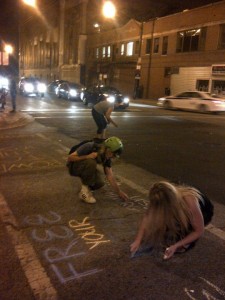
The location chosen for Saturday night’s action was a section of Uptown that had been blocked off by the city that weekend for Ribfest. It was perfect for our purposes - the streets were closed, so we had a rather large canvas to work with. We were right outside a train stop, so there were plenty of people walking by to see our work. And the next morning the streets would be full of hundreds more who could be influenced, however slightly, by our messages.
As I parked my car nearby, I sent a message to the friend who had initially tweeted out the action to check exactly where everyone was meeting. When I glanced at my Twitter feed, however, I saw that he was in the process of being arrested. Whoops. He was charged with disturbing the peace for the chalking, along with another unrelated charge. Not the best start to the night.
After CPD got done threatening everybody else with arrest, they took him away and the rest of us continued chalking. Many people stopped to talk with us - most in support or out of curiosity, although a few were upset by our action. They said it was vandalism and illegal. They said it was a childish way to express ourselves. They said it wasn’t a proper use of our First Amendment rights. Of course, we disagreed. We tried to explain why but the few who came looking for an argument weren’t interested in listening, unfortunately.
Thankfully we had an overwhelming amount of support from others we spoke with. We moved to two other locations and had the opportunity to talk to many more people-including Ribfest security guards, who didn’t try to stop us at all but actually encouraged us to continue. They told us they agreed with our messages and pointed out open areas that we hadn’t chalked up yet. “You missed a spot over there!” they would say, pointing, a mischievous grin pulling at the corners of their mouths.
The only disheartening thing to me was the number of people walking by who refused to take the chalk I offered and leave a message of their own. They would say, “No, it’s okay, you write one for me,” or “I don’t really have anything to say.” I want to do this again, all summer, all over the city, but put a greater emphasis on getting non-occupiers to leave their own messages. I want to give a voice to the people of Chicago in a simple, easy, dare I say fun way. I want to fill our streets with the words and ideas, hopes and dreams of the people who live and work here. I want to show my neighbors that you don’t need someone else to speak for you, that you don’t have to ask permission to be heard, that it’s acceptable and even laudable to share your thoughts creatively and publicly. I want to empower others as I have been empowered by the Occupy movement.
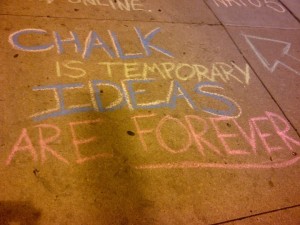
In one of the hottest, driest seasons our city has seen, our messages are likely to remain visible for a while. But even when they fade into the hot, dirty pavement, our words will live on. After all, chalk is temporary - ideas are forever.
Editor’s note: This story originally appeared at Resist, Occupy, Produce.
Los Ageles, CA-On Thursday at the Downtown Los Angeles monthly Art Walk, a police escalation erupted into an uprising of the people. All because Occupy Los Angeles activists organized an action around our right to free speech through chalking. The action started at 7pm, and immediately the police made aggressive arrests for using chalk on the sidewalk. By 9pm, hundreds of cops had amassed on 5th street, some in riot gear because the people of Los Angeles had taken it upon themselves to create their own art at Artwalk. Energy and anger buzzed around the crowd as people spilled into the streets from the filled sidewalks, furious and frightened at the amount of police. A woman of small stature was slammed to the ground, face first, and then arrested for using chalk on the streets. Her face was contorted in pain as three officers twisted her arms back to zip tie her wrists. People in the streets, yell “Shame.” Chants of “Whose Streets? Our Streets” and “Fuck the police” spread through the crowd.
But really, what did the police expect? They showed up in large numbers, with weapons and riot gear. A line of motorcycle cops formed, lights flashing, engines ready. As they moved forward, the crowd ran in a dizzying, angry and frightened manner. Riot cop lines formed on all sides of the intersection, pushing people in two directions - to Pershing Square and North on Spring. Guns with rubber bullets fired at the dispersing crowd. On Spring Street, I watched a man get shot at close range, stumble from the sidewalk into the street and collapse. I ran up to him to see if he was okay; as soon as I touched his shoulder, the police surged forward towards the man. One male officer pulled back his foot and kicked the man on the side. I saw him flinch, but ran back as an officer reaches for my arm. The man was grabbed and dragged behind police lines. His limp body was cuffed and taken away. The police continued to move forward, in what the media would call the next day clearing the area block by block. Every five feet, the police line stopped, and their commanding officer yes, “Maintain the line. Whatever you do, keep the line!” Otherwise, what? The several hundred frightened people on the street, who were at least thirty feet away, would rush the line? Was this a police who are supposed to protect and serve or a militaristic group attacking civilians?
Each time they advanced, both men on either side of the line would point their guns at the crowd threateningly aiming, occasionally firing in the crowd. I later heard that the Pershing Square contingent was tear gassed. Helicopters buzzed overhead, their lights shined on the streets. The crowd continued to mill around the streets, as the police continued to move forward. Tourists and groups of young people approached the riot line and take pictures. It was a spectacle now. Riot cops in downtown Los Angeles because of chalking. The city was shut down - streets are blocked off, freeways are jammed, the train stops are closed. Clearly this is bigger than just chalk.
When we started to organize around the Central City Association after May 1st, we knew it was a good target. After all the CCA is money in politics, it is corruption, it is a pretty big gear in the system we are trying to fight. Since our siege on CCA began, we have continually faced state repression vis-a-vis the police. It has not stopped. Captain Frank is always there lurking in the background, at least when he’s not dressed in his suit and lunching with the CCA members (as he did last month!) We have a hit nerve. Several nerves. CCA. And then the idea of private property and free speech. Free speech is not really free - we are limited to where, when and how we can exercise our right to free speech. The state makes laws in order to repress the people. Our founding fathers had no qualms about admitting that - we cannot have a true democracy, because the mass of the people must be controlled. That is the basis of our principle of democracy, that only certain people have the authority to do what they want, the rest of us must obey their laws. The masses of the people are stupid, illiterate gremlins. We cannot allow the masses to rule. It is the marginalized masses who are criminalized by most laws. This is why you cannot sit, you cannot lie, you cannot have your belongings with you on the streets of Los Angeles. Laws are made to criminalize the bodies and the existence of those who do not fit into our society.
So this is not really about chalk. It is about repression. It is about who has the authority. It is about who has the control. It is not us, it is them. And they are trying to turn the rest of the us against us. But we have to see through the media fog and their justification of their action. We must stand together as humans and realize that there are bigger problems in our society: poverty, inequality and corruption - in a word, capitalism. Capitalism is the systemic problem. This movement, which is sometimes called Occupy, for better or worse, and may never admit it, is anti-capitalist. Somewhere in its decentralized core, Occupy is about abolishing the system and restructuring our society in a completely different way. Occupy dares to shake the status quo. What happened at Art Walk is what happens to us, activists, and us, houseless, poor, and of color, all the time. We are brutally arrested, we are kicked, we are harassed by the police. Welcome, Art Walkers, to our life; welcome to the new phase of this movement: state repression.
Editor’s note: This post is part of our #NatGat coverage. You may read more #NatGat-related stories here.
Philadelphia, PA-There was a synchronicity manifesting at the Gathering:
There was a large canvas Declaration of Interdependence at the campsite for everyone to sign.
The Direct Action Flâneurs were there with a giant typewriter for everyone to type on a Declaration of Interdependence.
And I had brought the Threefold Declaration, which included a Declaration of Economic Interdependence.
In one of the Trainings, there was talk about making a direct action at Independence Hall. A smaller group took the idea up. People agreed that some action should be taken on such a symbolic day and symbolic place as July 4th, 2012 at Independence Hall-but no one could agree on what to do. We started organizing, spreading the word, and drafting a statement, but as the day approached, it gradually fell apart. Me and another fellow decided to make a last-ditch effort, but he was delayed, and so it turned out that on the morning of Independence Day, I was the only one who showed up.
The Occupy Legal Team had requested that they be notified of any Autonomous Actions beforehand, and this was turning out to be an entirely autonomous, Autarchic Action, so I called them and notified them.
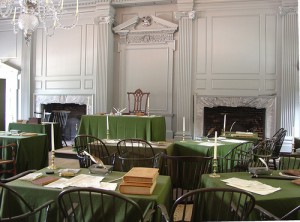
At 9:00 in the morning, I continued on to Independence Hall, and took the first tour. At the end of the tour, in the room where the Founding Fathers signed the Declaration, I stepped over the barrier. I said “don’t worry” to the other citizens, and I walked right up to the desk where the original Declaration of Independence was signed by John Hancock. It got really quiet.
I set down the written Declaration I’d brought with me, and I signed it right there on the desk. Then I unfolded the Solidarity Economy flag I’d made, and I spoke extemporaneously to the citizenry. This is approximately what I said:
“In the name of People of the United States-the American People-we declare our independence from Corporations, and our Interdependence with one another. This is a flag for an Interdependent Economy of America-for an Occupied Economy achieved through the Separation of Business and State.”
The other citizens were calm and listened to me. When I’d finished, the ranger said that he understood and related to “what you all are trying to accomplish”, and requested that I leave. I had said what I came to say, and I wrapped myself in the flag and walked out.
In the foyer of the Hall, the National Park Police and Rangers were in full scramble mode. I was arrested and imprisoned in the Federal Detention Center. It was worth it.
In there, I met up with the one Occupier who was still in prison, who’d been imprisoned since the tent-ring on Saturday: 20-year old Nate St.-Martin from New Haven, CT.
I was accused of two misdemeanors: Entering a Closed Federal Area and Interfering with a Federal Officer. We were both released the next afternoon, July 5th.
(Side note: when we organize an Occupy event, we ought to make sure we tell participants to write the phone number of the legal team ON THEIR ARM WITH PEN OR MARKER when they are going on a march or action, because police simply take all one’s papers, including slips of paper with phone numbers, and won’t give them back. Both Nate and I were not able to phone the Occupy Legal Team because of this.)
I got my own “occupy uniform” because the Federal Bureau of Prisons mailed my clothes to my home in upstate NY. So I left with a cool gray federal prison jumpsuit, size XXX Large. It’s actually pretty comfortable, and I felt it was a fitting outfit for present-day America. And it made a striking complement to my “Red Square, Blue Stripes” economic flag that served as my sun-screen and blanket as I continued on.
As I was leaving town that night, I walked up to a random person on the street to ask for directions, and he was astonished (and I was too): he was the Park Service tour guide at the Declaration of Interdependence! We spoke amiably for awhile, he asked to take my picture, and he looked on his phone for directions for where I needed to go. We shook hands and wished each other good luck.
Editor’s note: This post is part of our #NatGat coverage. You can read the author’s coverage of the first day of #NatGat by clicking here.
Philadelphia, PA-The second day of the Occupy National Gathering began with some sense of stability, with Franklin Square set as the permanent location for workshops and the Friends Center’s parking lot as the permanent sleeping area. However, the day of speakers and skill-shares precipitated an evening of arrests, with 25-30 reportedly taken into custody.
The morning of thematic meet-ups was followed by a series of speeches by activists like Occupier Lisa Fithian and CounterPunch contributor Mark Provost. At around 2:00pm, Occupiers broke out into workshops that ranged from the Money Out of Politics Voting Bloc to Code Pink.
A group of protesters, including many who are part of All In The Red, led a casserole march against debt, in solidarity with Montreal’s student strike. The protesters donning red squares were blocked off at Penn’s landing by a line of police. While there were arguments with police, and brief physical contact when cops let civilians pass through the line, there was no real confrontation.
At 6:00pm, Chris Hedges addressed the crowd of Occupiers. Hedges described the state of political America, including the death of the radical class, the “monstrosity of faux liberals like Bill Clinton and Barack Obama,” and the marginalization of structural critique in political discourse. He addressed Occupy’s future, articulating Occupy’s immediate goal “to reverse the corporate coup d’état and put the power back in the hands of people.” Hedges opined that the black bloc’s tactics are destructive because it plays into the hands “of those who want to destroy us” by demonizing Occupy in the mind of the public. But he remained hopeful and urged patience, citing his experience in movements that took time to build: “This is the dress rehearsal for the end of the corporate state.”
At 7:15pm, the first Occupy National Gathering Feminist General Assembly met. Through small and large group discussions, the participants in the FemGA shared how feminism can be alienating, shared common objectives (like ending sexual violence and strict gender roles) and listed the main goals of the FemGA.
By 9:00pm, Occupiers some were getting ready to settle into the parking lot at 4th and Arch and others were preparing to march in a jail solidarity protest. At around 10:30pm, a group of marching protesters were kettled and arrested. Cops used bikes to push Occupiers and refused calls by protesters to explain the charges. Of the 27 reportedly arrested, 7 were released by 9:45am. Others are being released slowly.
Editors note: This was originally posted on Diatribe Media. It is the last of a three-part series; read Part One and Part Two.
Chicago, IL-My gentle friend was returned to state custody even as I willed otherwise. Three days later, my Occupy Chicago brothers and I sat on cold stone benches, watching families visit their fathers for the hallmark holiday. We drove to visit our comrade together because that’s what families do. It was a hot Sunday, and I had finally entered the waiting area after being reminded my tank top was not welcome and I had to cover my body in a tee-shirt. At our comrade’s cellblock division, the guards did not perform the vigorous pat-down we found in other sections, even though they’re all part of the same Cook County system. In this division, number 6, my brothers and I simply dumped our nearly-empty pockets into bins and walked through metal detectors. At this entry point, the guards didn’t slap my breasts around, for which I was grateful. The last time I tried to visit my comrades and forced to consent to the state touching my body, my tits ached for days. Even though female guards were the ones searching my delicate skin for weapons, drugs, or maybe cigarettes, they still used the backs of their hands while I stood stock-still, rooted to the ground, choking on rage.After turning in our identification and while waiting for our background checks to clear, we sat on chilly marble benches, no phones or cigarettes to pass the endless time. We had hoped to also visit one of the NATO5 political prisoners that day, but it was looking unlikely we’d even see our solidaritécomrade.
One side of the cavernous waiting room boasted lockers, above which a sign reading “Visitor Lockers” was posted. Across the room, another sign read “Gun Lockers”. One of my brothers remarked it was like a high school football scoreboard: home versus visitors. He was right. They have guns. We have car keys and chapstick, our cellphones locked in my car. It’s truly an unfair fight and we are on their turf. Occupy Chicago’s lawyer told us recently that we were fighting an information insurrection. At that moment, we were defenseless. We could only compile mental notes.
Theoretically for aesthetics, tiny windows were cut in to the towering, multistory beige walls, making the square panels into block-shaped cartoon faces, with thin straight lines for mouths. I imagined them whispering to each other, reporting the sadness they had collected from the day after visiting hours were over. The energy was oppressive, depressive. At times, I could barely breathe with the weight of it all. I was waiting on the state, watching the minutes tick down as I gave them my coerced consent to check my background for warrants, forced permission for them to learn my name and address so I could offer some comfort to a fellow activist who had committed no crime. I would lean my head on my nearest brother’s shoulder, seeking reassurance that being locked in this bastard cop nest was the right direct action to take. Realizing the entire situation’s gravity, my brothers and I reached consensus that we would appear as boisterous and happy as humanly possible when we speaking with our comrade. We were all uncomfortable with Cook County’s chill, the process, and the environment and we’d only been there a few hours. Unlike our comrade, we could leave. His cold concrete cell was not our home. We were just the visiting team.
The guards would bark at the guests, uncaring they were addressing humans, with earnest need to see their dearests. Looking around, the floor in the waiting area was covered in food scraps and garbage. The restrooms had no toilet paper. Not only were the prisoners treated as subhuman, undeserving of quality and care, we, their visitors, were as well.
Groups of visitors, mostly children, mothers, and daughters came and went in 25 minute intervals. After each, I chirped to my family, “we’re up next!” until the room cleared out and finally the three of us, a couple and a man in wheelchair were directed into Visitation Room One. The visitation room was an ugly smoker’s yellow. The walls used to be white but had been exposed to so much exhaled nicotine, they began to turn a sickly morning-piss color. I longed for the open sky. Possibly as a cruel joke, we sat in plastic outdoor chairs. They were rickety and dirty. Our eyes were drawn to an unwieldy contraption before us and as one, we grimaced. A communication unit divided us from our fellow visitors and their time with loved ones, but that didn’t offer much space or privacy for conversation. In front of us all, a large black metal box with a centered video screen, an ATM-camera, and a payphone handset was the only connection to our comrade. There were no windows, just walls and a protruding box. We picked up the phone preemptively and the guard yelled at us, making everyone jump. Apparently, one mishandling of the 1990s-model telephone and the entire prison-industrial complex collapses.
Finally, we were instructed to pick up the handset and the monitor lit up, displaying our friend’s face. As one, my brothers and I beamed love and excitement into camera. We greeted him as one would a visiting dearheart, with “heyyyyyyy!’s” and grins bright enough to illumine the night. The conversation was hard, as we three had to share one phone. For the entire 15 minutes, two of us weren’t able to hear what our comrade was saying to me or our brother. The video camera which relayed his image into our screen was angled down, so we all stared at the crown of his head. We rarely saw his eyes or his smile. I hadn’t spoken to our fellow Occupier before picking up that handset. I had seen him around at our Cermak office, General Assembly and actions, but I flit in and out of Chicago so quickly, I simply hadn’t the time to befriend him past my congenial wave and smile. Now I was speaking with him, laughing with him. This person for whose freedom I’d worked so hard for staring at me from a black box in a wall. I tried not to cry. His arm was bandaged and in a sling. He said his arm had been fractured at the elbow. He didn’t say how. It was smart of him to keep quiet, as the communication device doubled as a recorder.
Realizing this and the breadth of the entire situation, my eyes widened and filled before I could choke back my emotions. I wasn’t conscious of reaching for my brother’s hand until I felt him in my own. My hand was slick and cold; my face masking my inner rage and sadness at the broken systems of government and law. We told him all of time, energy, efforts, care, and concern we were actualizing for him. We asked him how we could make his existence in there easier. He asked for Bukowski, commissary funds for toilet paper, and to let Occupy Detroit know he was all right. We promised to accomplish all of those requests. The final five minutes of our 15 minute visit was counted down digitally in the upper right corner of the video screen. We said good-bye and the video monitor blinked off. As the screen went black, I felt the forced light and levity I’d been projecting to bolster him fade away. My chest hollowed and I sat in that dirty, flimsy chair for a moment with my head hanging down, face in my hands. Simply, my brain was overwhelmed at the abject cruelty of the state and the lies of those bastards who ripped a gentle man from his world, in order to prove a point to we who speak out against repression, we who attempt to build a better world for all people.
As we walked silently through the doors and into the sunlight, the chill from that prison lingered in my bones. Leaving the cold rooms with the dirty floors and power-drunk guards is next to unbearable. Even though we go home, we’re not gone. We remain in locked away in our visited comrade’s memory, in the remains of the endless day locked away from all known beauty and joy. One of the Occupy family will be back the next visiting day. Jail support is hard on me, hard on my delicate heart, but serving jail time would be impossible without comrades, like me, like anyone who can harden their hearts and stand up in solidarity to the state. By dedicating time and energy to support our caged friends, we’re demonstrating to the state, the world, and to each other that their cases will not be forgotten.
Editor’s note: a version of this story originally appeared on Ryan Rice’s blog.
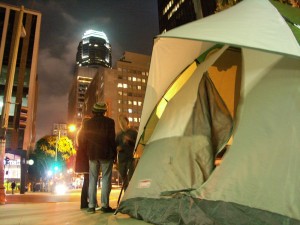
Los Angeles, CA-Los Angeles residents have been laying siege to the Central City Association for nearly a month. The people have been dutifully operating within the law, pitching tents at 9 p.m. and breaking down camp by 6 a.m. right in front of the “1%’s” lobby here in Los Angeles. In the day, we occupy Pershing Square and outreach, rest, and build our community. The people involved have been arrested and harassed, and it is escalating each day we camp at the doorsteps of corporate power.
Who exactly is the CCA? Their clients include Bank of America, Wells Fargo, Boeing, Target, US Bank, Verizon, Chevron, Walmart, and AT&T. They have the ear of the City Council and mayor as they push pro-business, anti-people regulations and laws. They are the shockingly overt bridge between money and politics.
In short, they are the perfect villain – both symbolically and literally. They represent Wall St. and profits over people. They represent how policies driven by corporate cash work to oppress the poor, elderly, and communities of color. They are behind gentrification in downtown LA, evictions, rent hikes, harassment, LAPD thuggery, and government ordinances against the “99%”.
Occupiers, most of whom are themselves houseless, have been peacefully gathering every night to protest the Economic Development Meeting and the downtown 2020 plan to build new high rises, the AEG Stadium and further criminalize dissent and push out the homeless. These are some of the things they are lobbying for:
Action: Advocate for lifting the Jones settlement to enable equitable enforcement of laws that keep sidewalks available to all. (More info on Jones settlement)
Action: Expand on efforts to end the pathological tolerance of the service-resistant and/or drug-addicted chronically homeless who choose to self-destruct on our public streets.
Action: Partner with BIDs, LAPD, and City Attorney to identify problem areas and issues, then implement strategic, consistent law enforcement (e.g., aggressive panhandling, proliferation of shopping carts, intelligence-based graffiti removal).
So we had four arrests last night. Here are some thoughts and testimonies to the terror plot orchestrated by the LAPD around midnight, the night of June 21, 2012.
My first thoughts written last night:
4 Arrests in Midnight LAPD Raid on CCA Siege – Occupy Los Angeles – three of my best friends and roommates, and an unknown 4th man ARRESTED. Charges unknown. Police orchestrated tactical raid with 25+ cops, pepper spray out and batons swinging. Captain Frank (at a compañera’s trial yesterday) pointed at her and said, “Don’t I know you?” Another police officer told a fifth occupier that “You’re getting arrested tomorrow.”
I couldn’t move, trapped inside a tent and seeing silhouettes of gum-chewing cops, fidgety and in war-mode. LAPD’s true colors emerging.
You want to talk targeted kidnappings and terror? Cops were laughing as they pushed and hit us. Laughing as they sent 3 snatch squads and took my friends in the dead of night.
We’re traumatized and enraged. Three of my roommates were snatched by LAPD last night. Bails are $50,000, $25,000, and $10,000. They’ve been some of the most visible organizers with the siege on the Central City Association (1%’s lobby here in Los Angeles) for nearly a month. They have all been harassed, intimidated, brutalized, and arrested by the LAPD before. They have all been occupying for months and are inspiring in their defiance and rejection of the oppressive status quo.
It began, yet again, with chalk. We’ve had five arrests for chalking at #626Wilshire, despite the 9th circuit court decision of Mackinney vs. Neilson (1995) that states: “No chalk would damage a sidewalk.” This information, along with a cease & desist letter from the National Lawyers’ Guild in Los Angeles, has been sent to the LA Police Department. Clearly they don’t care, as the first arrest of the night was for chalking. An unknown man was quickly arrested as the raid materialized from around both corners.
I was in my tent sleeping and was awoken to screams, shouts, and crying. No sirens, no instructions on a bullhorn – there was a frightening SILENCE of legitimacy as 25+ LAPD officers came out of nowhere and ambushed the peaceful, LAWFUL encampment in front of the CCA. I did not go outside.
I did not go outside because I saw silhouettes of cops with batons surrounding my tent. I did not go outside because I was threatened with arrest and flagged as a “leader” in El Segundo on Tuesday at an anti-drone military-industrial complex action. I did not go outside because the day before (June 20), I was nearly taken into custody for an alleged bench warrant. IN OPEN COURT in which I WAS A WITNESS YET TO TESTIFY. The judge said, “That reeks of witness intimidation” and wouldn’t allow it. I didn’t go outside because I heard some of the strongest comrades I know shouting in fear and uncontrollably crying in confusion and terror. The silence from the LAPD was deafening.
I did not go outside of my hiding place because I am a political dissident the State is targeting.
So I listened.
Here’s a report-back from an OccupyLA participant laying siege to the Central City Association:
Tonight at 626Wilshire the police assaulted the camp because one lone participant was chalking. They surrounded him, wrestling him to the ground, unable to site the code they were enforcing. We reminded them that chalk is not vandalism, that it is not graffiti, it washes off, and at bare minimum it is free political speech.
We stood there, six peaceful protesters, standing our ground observing this injustice- filming the police. Questioning their authority. One pig tells us,“Move to the corner of the sidewalk” and “If you don’t do what I tell you, I will make you”.
We had not moved any closer, we were not any threat to the police officers. We were peaceful protesters. The police called back up. Squad car after squad car pulled up. They took out their batons. They took out their pepper spray. They began screaming in our face. They incited violence and began beating us. They dragged away three of our comrades. They were laughing. We stood our ground. They are the terrorists of the police state. Any fucking pig with a badge, baton and gun is a coward. LAPD is a fully funded, militarized gang.
As I write this, I am listening to the streamer broadcasting the current but temporary eviction of Occupy Skid Row. 5 tickets have been issued, some of the VERY SAME cops from last night are taping off the area as dump trucks and bulldozers move in to continue criminalizing the homeless.
Read about the Siege on the Central City Association here. Read about gentrification here. This fight is in the streets and the people have picked the perfect situation to build a hyper-localized community of resistance. To build revolution, as so many say, we must start from the ground up. The houseless, the disaffected, the broke and hungry… they’re in the streets, they’re in jail, and they’re fighting back. Join us.
New York, NY-Monday afternoon I refreshed my Facebook newsfeed to find some unsettling news: Mark Adams, one of the 8 occupiers on trial for trespassing on December 17 last year, had just been sentenced to 45 days on Rikers Island. Admittedly I hadn’t followed the trial as well as many others, nor do I personally know Mark, but I was familiar enough with the #D17 action and trial that Mark’s sentence, 15 days longer than what the DA had asked for, seemed excessive and that charges hadn’t been dropped by Trinity was ridiculous in the first place.
So I decided to halt things and run to Foley Square that evening to show my support for Mark with other protesters.
I got there early at 7pm, meeting with a small group of comrades sitting by the fountain near the southern part of the park. A live streamer was on hand, giving anyone who was there in support of Mark a chance to tell his audience their thoughts or feelings about the trial As we mulled about, a few made signs, many of which had drawings of thick beards to hold before one’s face, because “We are all Mark Adams.” I looked across Centre Street at the Supreme Court building, whose engraving read that “the true administration of justice is the firmest pillar of good government.” I didn’t know what to make of those words that evening, except for a feeling that as things continue, more and more can only wake up and see that the state is not working in their interests.
I had come out to support, unsure of what we would be up to tonight. I asked a few people but others were confused as I was. And just where was everyone? I overheard we would be marching and saw on Twitter that the Feminist GA was happening. The plan was to march to Reverend Cooper’s home in the village, where we would hold a vigil. By then, the Feminist GA would be done and would meet us there, after which we would discuss our feelings about Mark and what had happened to him.
We left Foley just around 8pm, chanting “Free Mark Adams and all political prisoners.” If there’s one thing you can count on our community doing, it’s making light of terrible situations, so another popular chant was “We want the sexy bearded man (and so do you!)” It was probably not the best chant for outreach, but it boosted morale in a situation that many were angered and deeply saddened by. We eventually took the streets, mic-checking outside of opened-window restaurant fronts and tour buses to explain why we were out tonight.
One tour guide called the police, or threatened to, while we blocked her bus from moving, but we didn’t care; we’d established before leaving Foley Square that we would not be arrested, that if we saw the police we would simply rush to the sidewalk and comply with the rules. We didn’t want to be too controversial, because Mark would be upset if our rally to show solidarity with him ended up with more people being arrested. That isn’t to say there was no small drama: one man heckled us out his window, high above, and another threw an egg at us some blocks away. But we kept on.
Aside from passing a cop car that happened to be parked along a sidewalk we marched down, there was no police presence until we made it to Cooper’s home. We congratulated ourselves on marching through the streets with no conflicts with authority, and organized ourselves on the sidewalk, careful to keep it open for pedestrian traffic. Someone had brought small candles, which were passed out and lit.
A couple of police officers crossed the street to ask us what we were doing. There seemed to be nothing very accusatory about it, just asking what a random group of people congregating on a residential street planned to do there. We explained Mark’s story and that we were only here as bodies and to discuss what had happened. The police were cool about it and told us all was well so long as we kept the sidewalk open.
Eventually a white shirt came and interrupted us all to repeat to us that the sidewalk and stoop must be clear. The sidewalk and stoop were already clear, which made the whole thing redundant, and his tone lacked the courtesy that the previous two officers spoke with. He—and a couple new officers—spent the rest of the time occupying the stoop himself.
Someone who had spoken to the officers earlier said that Cooper was in fact home, that he’d called the police because he would not face us. Cooper was being cowardly and bringing in his own personal guards, courtesy of the NYPD. But still we complied with the police—we had no intent on blocking anyone from anything in the first place—and no issues arose. We watched out for each other, policing ourselves in regards to pedestrian traffic. We began our speak-out session, in which peoples words were carried down the line of us over different generations of mic-checks.
Where the march’s atmosphere was somewhere between celebratory and anger, this quiet moment was a mix between sadness and inspiration. Some talked about their hopes that Mark might organize from prison; others expressed that the best way we could support Mark would be through our actions and by looking at his enthusiasm and attitude as example. Someone pointed out that we kept talking about him in past-tense, that he was not dead and we would see him again. This comment got a few chuckles and brought the mood up a little bit.
I wondered what the police officers were thinking or feeling about all of these words. They understand sacrifice and must have understood that this trial was a moment in which we all realized that our sacrifices are in fact very real. But our group tonight was showing no signs of being discouraged, and I think the vigil presented a very human look at us that might sometimes be lost in the heat of an action. It’s consistently difficult to rank beautiful moments in the Occupy Wall Street community, but I think all of us coming together the night of June 18th is among one of the most poignant.
I went home carrying my cardboard Mark Adam beard. I didn’t want to throw it away or abandon it. So I put it on my desk, in the hopes that when I feel lazy or exasperated while working or question whether anything I do is worth it all, I can be reminded of Mark’s example and get shit done with a smile. So I’ll thank him for that when he returns, because he will.